
How to Choose the Right Soaping Agent for Your Dyeing Mill? In a dyeing mill, one process step looks routine. But it directly decides color fastness, brightness, and pass rate. That step is soaping. But do you really understand soaping agents? Why do floating dyes remain after washing? Why does white ground get stained? Why is the polyester-cotton process so long? Today, let us start with the basics. Then we give you four targeted soaping solutions. Understand the principles first. Then you can choose the right product.
1. Why use a soaping agent?
After dyeing or printing, fabric surfaces hold many unfixed or hydrolyzed dyes. We call these “floating dyes.” Water alone cannot wash them off. You need a soaping agent to get good rubbing fastness, washing fastness, and brightness.
What is soaping?
Soaping is a post-treatment process. It removes floating dyes, auxiliaries, and printing paste from textiles after dyeing or printing. Its goal is to improve color fastness and brightness. So it is a key step for quality.
What does soaping do?
It removes unfixed dyes and hydrolyzed dyes from fibers. It removes residual carriers, unreacted dye intermediates, and printing paste. It improves color fastness, brightness, and hand feel.
2. Why does soaping fail sometimes?
First, high temperature and high energy cost push mills to cut corners.
Traditional soaping needs 98°C for a certain time to strip floating dyes. But many factories lower temperature or shorten time to save cost or meet production targets. Then floating dyes stay on fabric. Worse, high temperature means high steam and electricity bills. Workshop temperatures can exceed 40°C in summer. Without heating, you cannot clean well. With heating, costs hurt.
Second, polyester-cotton blends need an extra reduction cleaning step.
After dyeing polyester, traditional process requires reduction cleaning to remove floating dyes from polyester. Then you dye cotton, then soaping. Each extra step adds water, waste, and risk. Many mills skip reduction cleaning or combine it poorly. Then floating dyes on polyester remain. Finished fabric fails to meet rubbing fastness requirements.
Third, reactive dye floating colors can redeposit. White ground becomes stained.
During soaping of reactive dyes, the biggest headache is not washing off the float, but re-staining after washing off. Common soaping agents lack enough dispersing and anti-staining power. When floating dye concentration saturates in the bath, dyes re-deposit on fabric – especially on white or light areas. This causes serious staining and low fastness.
First, acid printing often stains white ground.
For silk or nylon fabrics printed with acid dyes, white or light grounds are very sensitive to staining. Ordinary soaping agents either remove floating dyes poorly or have weak anti-staining performance. After washing, white ground turns gray or reddish. Light areas show mottled patches. Machine walls also get stained by dyes, adding downtime for cleaning.
3. Lianzhuang’s four soaping solutions
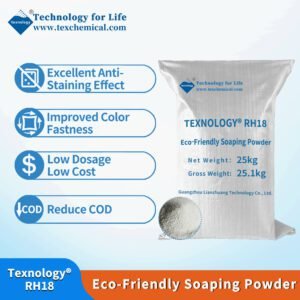
Solution 1: TEXNOLOGY®RH18 low-temperature soaping powder
Problem it solves:
High-temperature soaping consumes huge energy. Workshops get hot. Environmental pressure grows.
Core advantages:
Traditional process needs 98°C. TEXNOLOGY®RH18 works at only 60-80°C and gives the same soaping effect. It removes floating dyes thoroughly. Residual bath has low color load. This cuts wastewater treatment burden. It saves over 30% energy – less water, steam, and electricity. It also reduces workshop heat. It cuts 1-2 washing steps compared to traditional process. It contains no APEO and lowers COD/BOD discharge.
Application:
Cotton and its blends after dyeing or printing.
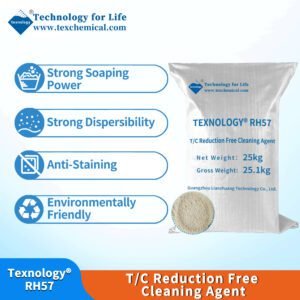
Solution 2: TEXNOLOGY®RH57 reduction Free cleaning Agent
Problem it solves:
Polyester-cotton blends need an extra reduction cleaning. The process becomes long and risky.
Core advantages:
Traditional process: dye polyester → reduction cleaning → dye cotton → soaping – too many steps. TEXNOLOGY®RH57 is an ammonium salt polymer. It allows no reduction cleaning. You just dye polyester, then go directly to cotton dyeing, then soaping. One bath does it all. This greatly shortens the process. It reduces water use and time. It also cuts fabric damage from long high-temperature runs.
It saves cost by removing the reduction cleaning step.
Application:
Polyester-cotton blends after dyeing – one-bath soaping.
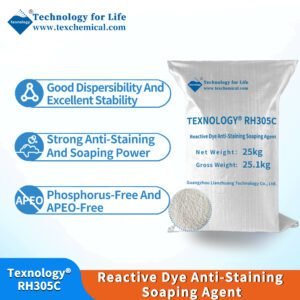
Solution 3: TEXNOLOGY®RH305C anti-staining soaping agent for reactive dyes
Problem it solves:
Reactive dye floats are hard to remove. White and light grounds stain easily. Fastness fails.
Core advantages:
TEXNOLOGY®RH305C is an acrylic polymer soaping agent. It comes as high-concentration powder. It contains no phosphorus or APEO. Its strong anti-staining works on reactive, direct, and disperse dyes. It removes floats, residual alkali, and electrolytes efficiently. It improves multiple fastness: rubbing, washing, and perspiration. Low foam design – works in overflow dyeing machines without clogging. Hard water resistant – chelates calcium, magnesium, and iron ions well, avoiding shade change. Low dosage, high efficiency – saves over 30% total cost.
Application:
Fabric dyed or printed with reactive, vat, or direct dyes – soaping and white ground protection.
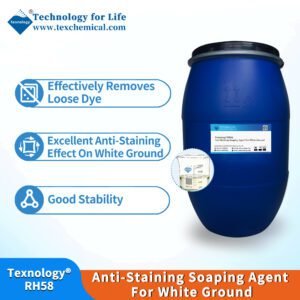
Solution 4: TEXNOLOGY®RH58 anti-staining agent for acid printing white ground
Problem it solves:
Acid printing causes severe white ground staining. Machines get secondary pollution. Whiteness drops.
Core advantages:
White ground staining is a big risk in acid printing. TEXNOLOGY®RH58 blends fatty amine polyoxyethylene derivatives, high polymers, and special surfactants. It is designed specifically for white ground protection. It significantly boosts whiteness – removes floating dyes and printing paste effectively. It prevents secondary staining on machine walls – cleaner equipment, less downtime. It is eco-friendly and biodegradable – meets Oeko-Tex 100. High concentration, dilutable – saves transport and application cost.
Application:
Nylon (polyamide), silk, wool – after acid dyeing or printing soaping.
Choose the right soaping agent. Save money and effort.
Whether you need low-temperature energy saving, polyester-cotton one-bath, reactive dye anti-staining, or acid printing white ground protection – Lianzhuang’s four products meet your exact needs.
