
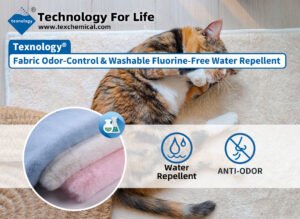
Pet textiles such as pet mats and pet clothing often absorb water, urine, and odors. Therefore, when a pet brand asks for both water repellency and odor control, dyeing and finishing plants need a reliable process. In addition, a Fabric Odor-Control Finishing Agent and a Washable Fluorine-Free Water Repellent can work together. As a result, this two-bath approach gives pet textiles dual protection.
Why Do Pet Textiles Need a Fabric Odor-Control Finishing Agent and Washable Fluorine-Free Water Repellent?
Pet urine odor mainly comes from ammonia. Specifically, ammonia molecules are small and volatile. Consequently, they easily attach to fiber surfaces and release odor again and again. Moreover, ordinary washing only removes surface residue for a short time. If ammonia remains inside the fibers, the odor soon returns. Meanwhile, pet textiles must resist water, urine, and other liquid stains. Therefore, a single finish rarely solves both liquid penetration and odor retention. For this reason, dyeing and finishing plants need a combined solution.
How Does the Two-Bath Process Apply Fabric Odor-Control Finishing Agent and Washable Fluorine-Free Water Repellent?
The key lies in the order: apply odor control first, then water repellency.
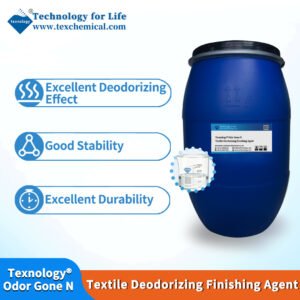
First, the Texnology®Odor-Gone-1 Fabric Odor-Control Finishing Agent works through physical adsorption. It forms a capture layer on the fiber surface. This layer adsorbs six major odor components: ammonia, trimethylamine, formaldehyde, xylene, acetic acid, and isovaleric acid. Once ammonia is fixed on the fabric, odor concentration drops. During washing, the captured odor molecules wash off, and the odor-control function recovers. As a result, the fabric can work repeatedly.
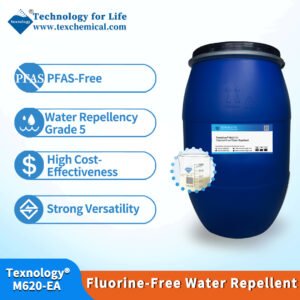
Next, apply the Texnology®M620 Washable Fluorine-Free Water Repellent. This polyurethane-type product forms a film on the fiber surface through padding. The film lowers surface energy and blocks water-based stains from wetting and penetrating. Its AATCC 22 spray rating reaches Grade 4 or above. Applying odor control first prevents the water-repellent film from blocking contact between the odor-control agent and the fiber surface. Applying water repellency afterward builds an outer barrier against liquid stains. Moreover, it does not affect the inner odor-control layer’s adsorption of ammonia. Therefore, the two finishes work without interfering with each other.
What Results Do Dyeing and Finishing Plants Achieve?
After the two-bath process, pet textiles keep good water repellency and odor control after repeated washing. The odor-control layer can wash off and recover. Meanwhile, the water-repellent layer stays stable through washing. Together, they meet the dual needs of pet mats and pet clothing for odor control and liquid protection. For dyeing and finishing plants, the two-bath route is clear. Conventional padding equipment can run it. Consequently, dyeing and finishing plants gain an efficient solution for dual-functional finishing of pet textiles.
About Guangzhou Lianzhuang Technology Co., Ltd.
Guangzhou Lianzhuang Technology Co., Ltd. has focused on R&D and production of textile functional finishing agents for 19 years. Its innovative finishing technologies give textiles richer and more diverse functional value. In addition, a professional development team and a scientific quality management system support its work. Therefore, the company provides textile, dyeing and printing, and garment enterprises with efficient, stable functional solutions that strengthen product competitiveness.