
Food packaging paper, paperboard, and molded pulp containers need oil repellency when they contact fatty foods. For years, the industry has used fluorinated oil repellents. Their main active ingredients are per‑ and polyfluoroalkyl substances (PFAS). They gave good oil resistance at low cost.
But PFAS persist in the environment. They do not break down naturally. They can also migrate from packaging into food, posing health risks. Global regulations are changing fast. In January 2025, the US FDA declared that 35 PFAS‑containing food contact notifications for paper and paperboard were no longer effective. The transition period ended in June 2025. The EU Packaging and Packaging Waste Regulation states that from August 2026, the content of any single PFAS substance in food contact packaging must not exceed 25 ppb. China’s GB 9685 revision also bans fluorinated compounds in food contact materials.
These rules mean that traditional fluorinated oil repellents are no longer allowed in food contact packaging. For molded pulp and food packaging paper producers, finding a compliant and effective non‑fluorinated alternative is now a technical necessity.
Why are fluorinated oil repellents being restricted?
The root cause lies in the carbon‑fluorine bond. It is one of the strongest covalent bonds in organic chemistry. It gives PFAS high chemical and thermal stability. This allows fluorinated oil repellents to form a low‑surface‑energy coating on pulp surfaces. They block oil effectively. But this also makes them hard to degrade in nature. They accumulate in soil, water, and living organisms. Studies show that fluorinated agents migrate into food. With more toxicological data and better detection methods, regulators consider the risks unacceptable. That is why they are phasing out approvals for food contact use.
How TEXNOLOGY® FFP fluorine‑free oil repellent works
TEXNOLOGY® FFP fluorine‑free oil repellent for pulp molding from Lianzhuang technology uses fluorine‑free polymers as active ingredients. You add it to the pulp or apply it by surface sizing. The polymer distributes evenly on the fiber surfaces and inside pores. Oil penetration into paper is essentially wetting and capillary wicking. So the key to oil repellency is changing the surface properties of the fibers. Oil repellency is usually measured by the Kit test (1–12 levels). A higher number means better oil resistance. Different applications need different Kit levels.
After film formation, the fluorine‑free polymer lowers the surface energy of the paper substrate. It increases the contact angle between oil and the paper surface. When the contact angle is large enough, oil cannot spread or wet the surface. It cannot penetrate through the capillary channels between fibers. Unlike fluorinated agents that rely on fluorocarbon chains, TEXNOLOGY® FFP fluorine free oil repellent for pulp molding uses a specially designed non‑fluorinated polymer structure. It builds a dense barrier layer on the molded pulp surface. This effectively blocks oil penetration.
Core advantages and applications of TEXNOLOGY® FFP
TEXNOLOGY® FFP offers a complete non‑fluorinated solution. Its core advantages are:
- Hot water resistance.After treatment, molded pulp containers resist hot water and hot soup‑based foods. They do not leak or deform when holding hot drinks or noodles. The container stays stable.
- Oil and grease resistance.The treated containers resist both low‑temperature and high‑temperature oils. This covers everything from chilled foods to hot meals and fried foods. It overcomes the common weakness of non‑fluorinated agents at high temperatures.
- Eco‑friendly and food‑compliant.The product contains no fluorine and no PFAS substances. It meets food contact safety requirements. It is suitable for packaging that touches food.
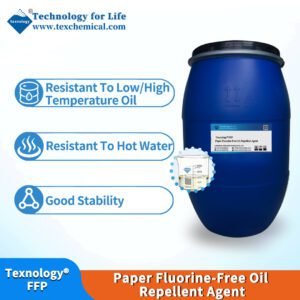
Application scenarios:
- Molded pulp containers– for takeaway, fast food, cafeterias. It solves oil penetration problems in oily meals.
- Food packaging paper and paperboard– burger wraps, oil‑proof paper bags, pizza boxes. It meets both oil resistance and food safety requirements.
- Specialty oil‑proof paper– for industrial or food uses that need grease barrier.
As fluorinated oil repellents are phased out, TEXNOLOGY® FFP fluorine‑free oil repellent gives packaging producers a ready‑to‑use solution. For product details or samples, please contact our technical team.
With over 20 years of deep focus in the textile auxiliary industry, Guangzhou Lianzhuang Technology Co., Ltd. has always been committed to the R&D, production, and application of auxiliaries.
From pretreatment to dyeing and then to finishing, we provide a truly one‑stop service for the textile printing and dyeing supply chain.
We insist on the philosophy “Let technology for life.” We not only offer standard products but also excel in developing customized functional finishes based on fabric needs, such as antibacterial, waterproof, flame retardant, softener, and antistatic solutions.
We make technology practical and production more efficient. For inquiries, please call: +86 18054231589
