
I. What is Antibacterial Fabric?
Antibacterial fabric is a type of functional textile that has been treated with antibacterial agents or contains inherently antibacterial fibers. It inhibits the growth of bacteria on the fabric surface at the source, effectively reducing odor caused by bacterial metabolism, and providing a “self-cleaning” sense of freshness and hygiene for clothing and home textiles.
The use of antibacterial fabrics has a long history. Among natural materials, hemp fiber is one of the most common antibacterial fibers, mainly because hemp plants contain flavonoids, which have strong antibacterial effects. Additionally, the hollow structure inside hemp fibers promotes higher oxygen content, helping to inhibit the growth of anaerobic bacteria.
II. Which Bacteria Can Antibacterial Fabrics Typically Inhibit?
In the post-pandemic era, as consumers’ health awareness continues to rise, the demand for antibacterial fabrics has grown significantly. So, which bacteria can antibacterial fabrics typically inhibit?
Common test strains for antibacterial performance include: Escherichia coli, Staphylococcus aureus, and Candida albicans.
III. Testing Methods for Fabric Antibacterial Performance
The evaluation standards for fabric antibacterial performance are mainly divided into three categories: National Standards (GB), Industry Standards (FZ), and International Standards (ISO/AATCC/JIS). Each standard differs in product scope, testing methods, and evaluation criteria.
IV.Classification of Antibacterial Grades
Antibacterial grades are distinguished based on the fabric’s resistance to washing and its antibacterial rate against various bacteria. Currently, 3A, 5A, and 7A antibacterial fabrics are widely promoted—what are the actual differences?
- 3A (AAA) grademeans the fabric retains antibacterial effectiveness after 50 washes.
The 3A grade originates from the textile industry standard FZ/T 73023-2006 “Antibacterial Knitwear”. This standard divides antibacterial knitwear into three levels (A, AA, AAA) based on washing durability and tested bacterial strains. The more As, the higher the grade and better the antibacterial performance. AAA is the highest level in this industry standard.
As for 5A and 7A, they are not part of the industry standard but are grades defined in recent group standards. For example, the “Antibacterial Textiles” group standard issued by Guangdong Provincial Standardization Association in 2022 divides antibacterial grades into seven levels, from low to high: A, AA, AAA, AAAA, AAAAA, AAAAAA, AAAAAAA—commonly referred to as 1A to 7A.
- 5A grademeans the fabric retains antibacterial effectiveness after 100 washes.
- 7A grademeans the fabric retains antibacterial effectiveness after 150 washes.
V. Classification & Application of lianzhuang technology‘s Fabric Antibacterial Agents
Silver Ion Antibacterial Agent – Durable & Wash-Resistant “Workhorse”
Silver ion antibacterial technology is the most widely used solution in the industry. Its mechanism involves positively charged silver ions interacting electrostatically with the negatively charged bacterial cell wall, disrupting the charge balance, causing cell wall rupture, and interfering with bacterial reproduction and growth.
Lianzhuang technology’s self-developed TEXNOLOGY® -FCG002 Silver Ion Antibacterial Finishing Agent uses a colorless and transparent nano-silver solution with a particle size of only 0.2–0.4 nm as the main antibacterial component, formulated through scientific compounding. Verified by production, it achieves an antibacterial effect of 99.99%, and retains over 99.9% after 50 washes. It meets the AAA level of FZ/T 73023-2006 “Antibacterial Knitwear”.
TEXNOLOGY® -FCG002 is suitable for durable, wash-resistant antibacterial finishing of various fabrics including cotton, blends, synthetics, nonwovens, and leather. It does not affect the fabric’s hand feel, color, or appearance.
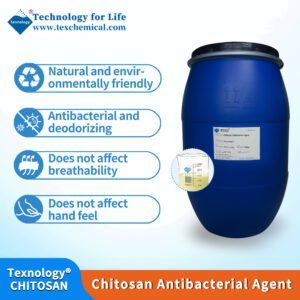
Chitosan Antibacterial Agent – Green & Natural “Eco-Friendly Choice”
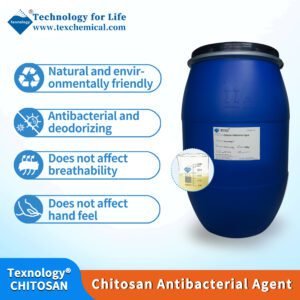
As consumers place more value on natural, skin-friendly, and eco-friendly concepts, bio-based antibacterial materials are gaining significant market traction. Lianzhuang technology has responded to this trend by launching TEXNOLOGY® -CHITOSAN Fabric Chitosan Antibacterial Agent.
This product is primarily made from chitosan extracted from the shells of shrimp, crabs, and other crustaceans, offering biodegradability and environmental compatibility. It disrupts bacterial cell membranes and inhibits common pathogens such as Staphylococcus aureus, Escherichia coli, and Candida albicans, with an antibacterial rate ≥90%, while also reducing metabolic odors—achieving both antibacterial and deodorant effects. The natural ingredient is highly biocompatible with the human body and non-irritating. Treated fabrics maintain their original breathability and softness. The processing method is simple, applicable via padding, dipping, or spraying. This product is mainly used for close-to-skin textiles such as underwear, infant clothing, towels, bed sheets, and socks.
The antibacterial mechanism of fabric antibacterial agents essentially works through a synergy of physical, chemical, and biological actions. The future direction of antibacterial technology lies not only in improving antibacterial efficiency but also in achieving safety, durability, and green chemistry—making the antibacterial effect “wash-resistant” while being more friendly to both humans and the environment.
As a manufacturer of fabric antibacterial agents, Lianzhuang technology is committed to maximizing the advantages of each antibacterial mechanism, providing textiles with reliable antibacterial protection.
If you are developing antibacterial textiles or would like to know which type of antibacterial agent is best suited for your product, please feel free to contact us for technical consultation.