
A polyester durable flame retardant can stop many common problems. But first, let us look at what goes wrong. Many dyeing mills notice the same trouble. After flame retardant finishing on polyester curtains, decorative fabrics, or webbing, the result often disappoints. The fabric feels hard like cardboard. Or the color shifts or bleeds. Or the flame retardant effect disappears after just a few washes. Sometimes, the product fails environmental standards too.
What causes these issues? The wrong choice of flame retardant.
A good polyester durable flame retardant keeps softness, preserves color, survives many washes, and meets eco rules. Texnology®ZRJ is one such product.
What Is Flame Retardant Finishing? Why Does Polyester Need a Durable Flame Retardant?
Flame retardant finishing uses chemicals or physical methods to change how fibers burn. The goal is simple: the fabric does not catch fire easily, or it stops burning quickly after the flame is removed. This lowers fire risk.
Pure polyester is a thermoplastic fiber. When it meets fire, it melts fast and burns. More dangerously, it produces hot dripping drops. If a drop lands on skin, it causes worse burns than direct flames.
Moreover, public places like hotels, hospitals, and cinemas have strict fire safety standards. In China, GB 20286 applies. Without flame retardancy, the fabric cannot be sold. Export orders also need BS5852, EN532, and other standards.
To get “self-extinguishing, no molten drops, good wash durability, no harm to fabric feel, and environmental compliance,” you need a special product. Texnology®ZRJ is a non-ionic polyester durable flame retardant. It dissolves easily in water. It works perfectly for durable flame retardant finishing on polyester fabrics.
Four Common Problems with Ordinary Flame Retardants
Many ordinary flame retardants create the following issues:
- Hard feel:Too much product forms a stiff film on the fiber surface. The fabric becomes rough and rigid.
- Color change or bleeding:The chemical reacts with dyes or uses the wrong pH. This causes batch-to-batch color differences.
- Poor wash durability:The flame retardant does not bond tightly with the fiber. After a few washes, the protection drops sharply.
- Eco failure:Traditional halogen-based flame retardants can release toxic smoke when heated.
Therefore, an ideal polyester durable flame retardant must solve all four problems at once: feel, color change, wash durability, and environmental safety.
How Does a Polyester Durable Flame Retardant Work?
Texnology®ZRJ uses a cyclic phosphonate ester as its main ingredient. This is a non-ionic compound.
Here is how it works. During high-temperature curing, it forms a dense and uniform protective layer on the polyester fiber surface. This layer blocks oxygen. This layer stops fire. This layer resists washing. When fire touches the fabric, this layer quickly chars. It blocks oxygen and slows heat transfer. As a result, the fabric self-extinguishes and produces no hot molten drops.
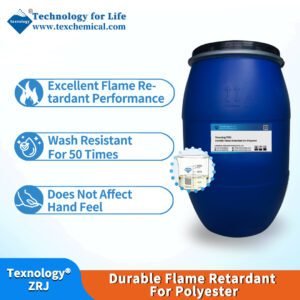
Importantly, this protective layer bonds strongly with the fiber. That is why the wash durability is excellent.
Now look at the key performance benefits:
- Standard passing:Use 100–200g/L of Texnology®ZRJ. It passes GB5455, BS5852, and other standards.
- High wash durability:It survives 30+ washes. Perfect for hotels, hospitals, and frequent washing.
- No hard feel:The product has very little impact on fabric hand feel. Strength and softness stay almost the same.
- No color change or bleeding:Avoids batch color differences.
- Eco-friendly:Halogen-free, low volatility, non-toxic. Meets environmental rules.
- Easy to use:Dissolves in water. Works on normal finishing machines. You can also use it with a water repellent in one bath to get flame retardant + waterproof function.
Suitable fabrics: Pure polyester curtains, non-wovens, decorative tapes, webbing, felt, automotive interiors, aircraft interiors, and more.
H3: Summary – From Painful Trade‑off to Best of Both Worlds
Let us go back to the core goal. Flame retardant finishing aims to make polyester fabric self-extinguish and produce no harmful drips. The flame retardant must form a protective layer on the fiber.
However, if you choose the wrong product or use poor process control, you get hard feel, color problems, poor wash durability, or environmental failures. These issues hurt production quality and delay orders.
Texnology®ZRJ changes the game. It ends the old trade‑off where “flame retardancy means sacrificing feel, color, washability, or eco-friendliness.”
Here is what makes it different:
- New mechanism:The cyclic phosphonate ester forms a strong protective layer. It chars on fire to block oxygen and stop drips. This also solves poor wash durability.
- Stable performance:No hard feel. Nearly no color change. Halogen‑free and safe.
- Easy process:No need to change your production line. Use normal pad-dry-cure (one dip, one nip → dry → cure). You can even add a water repellent in the same bath without extra steps.
For dyeing mills and fabric factories that want high flame retardant grades without hard feel, color failures, poor wash results, or environmental risks, this is a real upgrade. You move from “painful choice” to “both benefits.” One process, one setting. You get 30+ washes of flame retardant pass, original fabric quality, and happier customers.
