
Sweaty clothes sticking to the skin – uncomfortable and unpleasant. This is a top consumer complaint and a major challenge for sportswear brands. With rising demand for comfort in sportswear, outdoor gear, and premium underwear, fabrics with one‑way moisture transport are gaining popularity. Market research predicts the global market for one‑way moisture‑wicking elastic fabrics will reach nearly $8 billion by 2031. Whoever masters this process first gains a competitive edge.
1. What is one‑way moisture transport?
Simply put, it allows sweat or moisture to move from the inner (skin‑contact) layer to the outer (air‑exposed) layer, where it spreads and evaporates quickly, while outer moisture cannot migrate back. The core principle is differential capillary effect – creating a “hydrophobic‑hydrophilic” wetting gradient between inner and outer layers, forming a capillary pressure difference that drives directional moisture flow. The result: inner layer stays dry, outer layer evaporates fast.
2. Recommended products and process
For stable, reliable one‑way transport, we recommend a combination: TEXNOLOGY®M380 fluorine‑free waterproofing agent + TEXNOLOGY®G10 hydrophilic silicone softener.
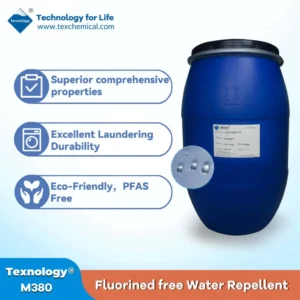
Step 1: Local hydrophobic treatment. Use a printing technique to apply TEXNOLOGY®M380 in a grid pattern on the inner (skin) side. TEXNOLOGY®M380 is a paraffin/acrylate blend. It gives excellent water repellency and good wash durability – 4‑5 grade before washing, and still effective after many washes. Importantly, it contains no PFOA or PFOS, meeting EU export standards and the industry’s fluorine‑free trend.
Step 2: Overall hydrophilic treatment. Then apply TEXNOLOGY®G10 hydrophilic silicone softener to the whole fabric. TEXNOLOGY®G10 is a specially modified silicone compound. It gives excellent moisture absorption and breathability, quickly wicking sweat away from the skin. It also offers anti‑static and low‑yellowing benefits.
Working together, these steps create a stable hydrophobic‑hydrophilic difference between inner and outer layers. Moisture moves through inner “hydrophilic channels” to the outer side and evaporates, while the inner layer stays dry.
Application tips: For TEXNOLOGY®M380 grid coating, use 5‑10% add‑on, dry at 110‑130°C, then cure at 150°C for 1‑3 min. For TEXNOLOGY®G10, use padding at 5‑10 g/L, dry and set at 130‑150°C for 2 min. Adjust dosages based on fabric type and actual conditions.
One‑way moisture transport is not just a technical upgrade – it is a leap in textile competitiveness. Choose the TEXNOLOGY®M380 + TEXNOLOGY®G10 combination to make your fabrics breathable, dry, and comfortable.
