
Environmental regulations on fluorochemicals keep getting stricter. Many textile brands now struggle to select the right textile water repellent for their fabrics. You often hear PFOS, PFOA, and PFAS – but what do they mean? How do they affect your choice? This article explains the relationships and helps you make a smart decision.
PFOS, PFOA, and PFAS – What They Mean
PFAS (per- and polyfluoroalkyl substances) form a huge chemical family. It contains thousands of compounds. Because they resist degradation, people call them “forever chemicals.” PFOS (perfluorooctane sulfonate) and PFOA (perfluorooctanoic acid) are two well-known members of this family.
In short, PFAS is the broad category. PFOS and PFOA are specific substances within it. Since scientists found PFOS and PFOA persistent, bioaccumulative, and toxic, international authorities first restricted these two.
From PFOS to PFOA to PFAS – How Regulations Reshape Textile Water Repellents
In 2009, the Stockholm Convention added PFOS to its Annex B. That restricted its use globally. Consequently, traditional C8 (carbon-eight) textile water repellents faced elimination – because they could degrade into PFOS during production and use.
Later, PFOA also faced restrictions. In 2019, the Convention placed PFOA and its salts in Annex A. C6 (carbon-six) textile water repellents contain no PFOS or PFOA. So they became the main replacement for C8. Many textile brands adopted C6 products widely.
However, recent trends show that regulators now target the entire PFAS family. Several European countries and North America have proposed total bans on all PFAS substances. That means any fluorinated textile water repellent – including C6 – may face future prohibition. Therefore, textile brands need to look ahead.
From C8 to C6 to C0 – The Evolution of Textile Water Repellents
Given tightening laws, textile brands should plan proactively.
C8 textile water repellent offer excellent water and oil repellency. But due to their environmental risks, they have largely left the market. Only a few special textiles (like protective workwear) with exemptions can still use them.
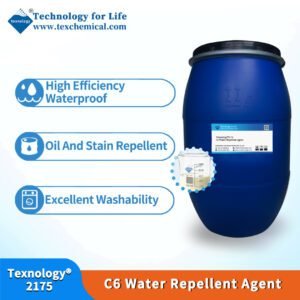
C6 textile water repellent are currently the common transitional choice. Take Texnology®2175 Washable C6 Textile Water Repellent as an example. It contains no PFOS or PFOA. It meets current domestic regulations. It gives fabrics outstanding water and oil repellency with good wash durability. It suits many cellulose, synthetic, and blended fabrics.
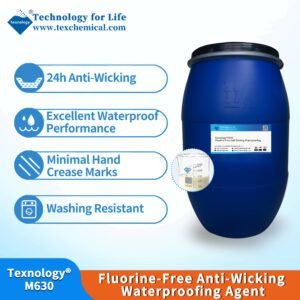
Nevertheless, given the overall PFAS restriction trend, fluorine-free textile water repellents offer a more future-proof solution for both export and domestic sales. For instance, Texnology®M630 Washable Fluorine-free Textile Water Repellent uses a polyurethane dispersion. It contains no fluorine and no APEO emulsifiers. Its environmental profile stands out. It provides excellent water repellency and also protects against water-based stains like juice and soy sauce. Moreover, it has little effect on fabric hand feel. It works well on synthetic fabrics, shoe materials, and webbing.
For textile brands, choosing the right textile water repellent now means balancing performance, durability, and regulatory compliance. C6 serves as a short-term option, but fluorine-free (C0) is the safer long-term investment.
About the company:
Guangzhou Lianzhuang Technology Co., Ltd. specializes in R&D and production of textile functional finishes. We aim to give textiles richer functional value and advance finishing technologies. Our professional team and scientific quality management system provide textile dyeing and garment enterprises with a wide range of efficient functional solutions for textiles.
