

When I visit textile fairs and dyeing mills these days, I notice a clear shift. Clients used to ask, “Is this fabric waterproof?” or “What is the flame retardant rating?” Now, more purchase orders come with a new requirement: “Can you add a mosquito repellent finish for textiles? And it must stay effective after many washes.”
This demand first emerged from fabric suppliers in Guangdong who make tent hotels. They received bad reviews on OTA platforms because of mosquitoes, and their boss panicked. They tried spray coatings, lamination, and even microencapsulated permethrin on the fabric surface.
However, these methods either ruined the hand feel or lost effectiveness after just two or three washes. Later, suppliers of outdoor patio umbrellas, high-end homestay bedding, and even star-hotel curtain fabrics in Jiangsu and Zhejiang started asking the same question. I then realized this is not a niche need; the entire textile industry is transforming.
As functional auxiliary agents suppliers, we essentially solve the “both-and” dilemma for downstream manufacturers. Many mosquito repellent products exist on the market, but fabric mills do not just need good lab data. They need a solution that does not stick to rollers during setting, does not cause yellowing, does not reduce color fastness, and still passes brand testing after twenty washes. When we developed the Texnology®️-MOS R90 mosquito repellent finish for textiles, we set a clear R&D roadmap. We did not want a single-use, short-term agent. Instead, we focused on long-lasting, sustained mosquito protection.
Now, let me walk you through the most critical details our clients care about during implementation.
Physical and chemical properties of the mosquito repellent finish for textiles
The Texnology®️MOS R90 mosquito repellent finish for textiles appears as a pale yellow, transparent liquid. It remains clear and free of sediment throughout processing. This feature clearly distinguishes it from common milky-white emulsion-type insect repellents. Additionally, the product uses a non-ionic system, which serves as the core reason for its excellent compatibility with various functional auxiliaries. A 1% dilution maintains a stable pH of 6.0±1.
Moreover, it dissolves quickly and completely in both cold and warm water. Therefore, you do not need prolonged stirring when preparing the working solution. During formulation, we also prioritized odor control. The final product has no pungent pesticide smell. This makes it suitable for hotel bedding and even fabrics that contact infant skin without leaving unpleasant residues.
Adaptability and protection scope of the finish
The Texnology®️MOS R90 mosquito repellent finish for textiles does not merely target common house mosquitoes. It delivers stable repellent effects against Aedes albopictus (Asian tiger mosquito, which transmits dengue fever), Culex quinquefasciatus, and Anopheles species. Furthermore, it also suppresses ants, cockroaches, dust mites, moths, and houseflies. Therefore, it covers a broad range of industrial textile needs. At the same time, this finish adapts to diverse fabric types. These include military tents, training uniforms, sports quick-dry fabrics, hotel and homestay bedding, light-colored sofa materials, mosquito nets, camping sleeping bags, and carpets. Whether you work with synthetic fibers or blended textiles, the padding process works seamlessly.
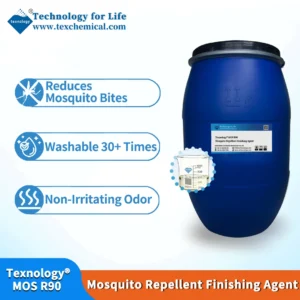
For practical application, we recommend two proven padding processes:
1. Standard single-application mosquito repellent process (short-term protection, lower cost)
2. Durable wash-resistant mosquito repellent process (preferred by long-term repeat clients, paired with MOS B fixing synergist)
A final note from experience
The textile market has faced tough conditions over the past two years. Profit margins for fabric mills remain thin. Many peers believe that adding a mosquito repellent finish for textiles only increases costs. They think customers should simply buy insect repellent spray instead. However, the reality is different. The entry barrier for mid-to-high-end orders has shifted. When brand owners include “long-lasting mosquito protection” in their procurement standards, you lose the chance to even bid if you do not offer it. Moreover, the added value this function brings far exceeds the auxiliary agent cost. You can sell fabric for two or three Dollars more per meter, and clients readily accept that premium. In fact, they appreciate the solution.