
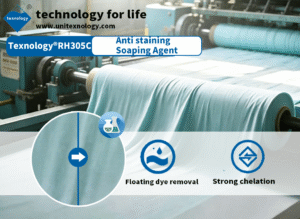
In reactive dye printing, soaping is the final—and often decisive—step that determines finished fabric quality. Reactive dyes offer a broad color range, bright shades, and moderate cost. However, during dyeing and printing, unfixed dyes and hydrolyzed dyes can account for as much as 20% to 40% of the total dye applied. If these loose colors are not thoroughly removed, they harm color fastness and brightness. Worse, they accumulate in the soaping bath and cause “secondary dyeing” on the fabric—leading to white ground staining, color bleeding between patterns, and other serious defects.
Traditional soaping agents often wash away loose dyes but fail to prevent redeposition. The dyes removed from the fabric can still return to the fabric surface in the hot soaping bath. That is exactly the core problem that Lianzhuang Chemical’s reactive printing anti-staining soaping agent aims to solve.
1. The Anti-Staining Mechanism of Texnology®️-RH305C Reactive Printing Anti-Staining Soaping Agent
Texnology®️-RH305C reactive printing anti-staining soaping agent is based on acrylic polymers. It offers excellent dispersion, adsorption, complexation, suspension, and cleaning power. Its anti-staining performance relies on a clear principle: the polymer adsorbs and disperses the washed-off loose dyes, stabilizing them in the soaping bath so they cannot redeposit onto the fabric. In practice, this agent effectively prevents dye back-staining after reactive printing, keeping white grounds clean. When used for washing cotton yarn-dyed fabrics and striped flat-knit collars, it prevents hydrolyzed dye from staining the white base. Additionally, it works well for removing unfixed dyes after dyeing and printing, as well as for degreasing and washing in silk production.
2. The Chelating Power of Texnology®️-RH305C Reactive Printing Anti-Staining Soaping Agent
Calcium, magnesium, and iron ions in water can combine with dyes to form insoluble lakes, which cause staining and shade changes. Therefore, a high-performance reactive printing anti-staining soaping agent must have strong chelating ability. Texnology®️-RH305C provides excellent chelation for calcium, magnesium, and iron salts. It effectively prevents metal ions from interfering with the soaping process. As a result, the finished fabric exhibits brighter and purer shades. This feature proves especially valuable in regions with hard water, as it significantly improves the first-pass success rate.
3. Process Flexibility and Environmental Benefits of Texnology®️-RH305C Reactive Printing Anti-Staining Soaping Agent
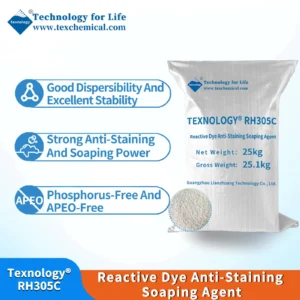
Texnology®️-RH305C reactive printing anti-staining soaping agent remains stable against various acids, alkalis, and electrolytes. It suits soaping and anti-staining applications for reactive, vat, and direct dyes in both printing and dyeing processes. For post-dyeing soaping, a dosage of only 0.2–0.3 g/L delivers outstanding results. For reactive print washing, a typical process includes 10 minutes at room temperature followed by 15 minutes at 95–100 °C. Moreover, under the “dual carbon” goals that drive the textile industry’s green transition, this product contains no phosphorus or APEO. It meets increasingly strict environmental regulations, helping printing and dyeing mills upgrade their processes while staying compliant.
Choosing the right reactive printing anti-staining soaping agent is not just about solving white ground staining—it is a practical way to raise first-pass yield and lower rework costs. Texnology®️-RH305C reactive printing anti-staining soaping agent empowers your printing and dyeing process upgrades, ensuring every batch stands up to the strictest quality checks. For printing and dyeing mills looking to reduce defects and improve efficiency, this agent delivers measurable results. And when printing and dyeing mills adopt it in their daily operations, they gain both process stability and peace of mind. Ultimately, printing and dyeing mills that prioritize anti-staining soaping agents like Texnology®️-RH305C will see fewer complaints, less waste, and more consistent production runs.