
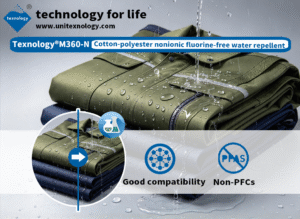
Fabric mills now face tighter environmental controls. Global brands and regulations restrict PFAS-related substances. As a result, fluorine-free water repellent finishing has become a key upgrade for fabric mills. However, polyester-cotton blends contain both cotton and polyester fibers. They often face ion conflicts, emulsion breakdown in one-bath processing, and white marks on fabric. Texnology®️M360-N Polyester-Cotton Non-Ionic Fluorine-Free Waterproofing Agent from Lianzhuang Chemical targets these pain points.
1. Why Does Polyester-Cotton Fabric Finishing Often Fail?
Polyester-cotton fabric combines cotton’s moisture absorption with polyester’s strong mechanical performance. As a result, fabric mills use it widely in home textiles, workwear, and casual clothing. However, this blend also creates finishing challenges. For example, many fabric mills use resin, coating, and other agents in one-bath processes. Yet most mainstream water repellents are cationic. Consequently, they can react with anionic resins and coatings, causing emulsion breakdown, white spots, roller sticking, and waterproofing spots. In turn, these defects raise reject rates. In addition, overseas orders often require PFAS-free and Non-PFCs. Therefore, traditional fluorine-containing water repellents no longer meet entry standards. For this reason, fabric mills need a compatible, stable, and environmentally compliant waterproofing solution.
2. Core Advantages of Polyester-Cotton Non-Ionic Fluorine-Free Waterproofing Agent
Strong ion compatibility supports multiple agents in one bath. The non-ionic structure is the biggest highlight of the Texnology®️M360-N Polyester-Cotton Non-Ionic Fluorine-Free Waterproofing Agent. It can work with anionic resins and anionic or cationic agent systems. It also offers strong interference resistance. One-bath processing removes separate steps, simplifies production, and improves dyeing and finishing efficiency.
Non-PFCs eco-friendly system. Texnology®️M360-N Polyester-Cotton Non-Ionic Fluorine-Free Waterproofing Agent uses a Non-PFCs system. It contains no perfluorinated persistent pollutants. Therefore, it helps fabrics pass export testing.
Fewer fabric defects and smaller hand-crush white marks. Many fluorine-free water repellent finishes cause hand-crush white marks or whitening. These marks affect product quality. In contrast, Texnology®️M360-N Polyester-Cotton Non-Ionic Fluorine-Free Waterproofing Agent forms a uniform film. It creates small hand-crush white marks, protects fabric appearance, and reduces rework losses.
3. Applications of Polyester-Cotton Non-Ionic Fluorine-Free Waterproofing Agent
Lianzhuang Chemical’s Polyester-Cotton Non-Ionic Fluorine-Free Waterproofing Agent fits production lines that need multiple agents in one bath. Fabric mills use it for casual fabrics, home textiles, workwear, and other waterproof upgrades. It works with a standard pad-dry-cure process. After padding, drying, and heat setting, it forms a uniform hydrophobic film on the fiber surface. This film gives the fabric water repellency.
4. Conclusion
Environmental dyeing and finishing agents and integrated processing are clear trends. However, many fabric mills still face strict PFAS-free requirements and unstable one-bath processing. Even so, by choosing a PFAS-free and stable fluorine-free water repellent system, fabric mills can avoid testing risks. In addition, they reduce defect rates and improve fabric competitiveness.