
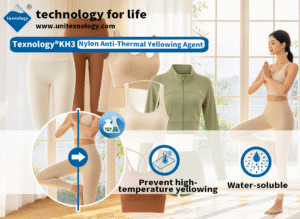
Heat setting is a must in dyeing and finishing nylon and its blends with elastane. It usually runs at 160–200°C. It stabilizes dimensions, reduces curling, and fixes width. However, high heat and oxygen can oxidize amino groups in nylon fibers. This oxidation causes yellowing. Light shades, optical brightened fabrics, and sensitive colors suffer most. Once yellowing occurs, rework costs rise. Severe cases lead to downgrades. Therefore, more fabric mills now focus on nylon anti-thermal yellowing agent. It is not a simple brightener. It is a functional finishing solution that targets the heat-setting yellowing pathway.
Why Does Heat-Setting Yellowing Happen?
Nylon heat-setting yellowing has complex causes. Fiber properties form the base. Spin oil residue, high-temperature decomposition of softeners, and NOx fumes from gas-heated stenters all trigger yellowing. Moreover, fabric mills often find the problem only after it occurs. At that point, the fabric has already set. Color shade and whiteness have locked in. Rework becomes difficult. This creates unnecessary losses. Therefore, yellowing control must move upstream. Do not rely on after-the-fact fixes.
How Does Texnology®️KH3 Nylon Anti-Thermal Yellowing Agent Work?
Texnology®️KH3 nylon anti-thermal yellowing agent uses special amine compounds as active ingredients. It evenly attaches to the fiber surface and interior during exhaustion or padding. When the fabric enters the high-temperature setting zone, active groups react first with sensitive groups on the fiber. They inhibit oxidation and degradation of color-forming groups. As a result, they block the yellowing pathway at the source. This chemical intervention does not lose effect after later washing. It also does not noticeably affect fabric hand or breathability.
Application Scenarios of Texnology®️KH3 Nylon Anti-Thermal Yellowing Agent
Texnology®️KH3 nylon anti-thermal yellowing agent suits anti-thermal yellowing finishing for nylon and its blends with elastane. It reduces high-temperature yellowing during pre-setting, post-setting, and mold pressing. It reduces shade change in light or sensitive colors after heat setting. Texnology®️KH3 nylon anti-thermal yellowing agent helps optical brightened fabrics achieve more stable whiteness. It also effectively prevents and reduces yellowing risk during heat setting for dimensional stability or curl removal. In addition, it reduces yellowing from 190–200°C mold pressing.
For fabric mills, nylon anti-thermal yellowing agent delivers more than anti-yellowing performance. Texnology®️KH3 nylon anti-thermal yellowing agent supports fabric upgrades and stable delivery. It helps improve first-pass setting success, reduces rework, and stabilizes shade and whiteness in light and optical brightened fabrics. As a result, fabric mills can control heat-setting yellowing before it hurts yield.