
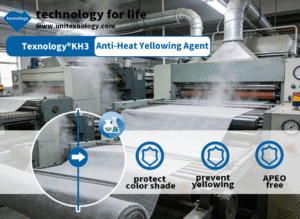
In the dyeing and finishing of nylon and nylon/spandex blended fabrics, heat-setting is a core process for ensuring dimensional stability. However, high-temperature treatments at 190–200°C during heat-setting and molding frequently cause irreversible yellowing on light-colored and white nylon fabrics. This defect leads to shade shifts, reduced whiteness, and higher rejection rates. For many fabric mills, this problem lowers product value and creates a major barrier to upgrading nylon textiles.
Why Does Nylon Turn Yellow Under Heat?
The root cause lies in the nylon fiber’s molecular structure. The terminal amine groups on nylon are highly susceptible to oxidation under high-temperature, oxygen-rich conditions. At the same time, residual auxiliaries on the fabric can participate in secondary reactions, generating yellow chromophores. White, pastel, and nylon/spandex elastic blends are particularly vulnerable. Once yellowing occurs, correction becomes extremely difficult. To address this at the source, selecting a suitable nylon anti-heat yellowing agent offers the most effective solution.
Texnology®️-KH3 Nylon Anti-Heat Yellowing Agent: Chemical Inhibition for Color Stability
Texnology®️-KH3 nylon anti-heat yellowing finishing agent is a specialty amine-based functional textile auxiliary. Unlike simple physical masking products, it intervenes chemically in the reaction chain. It inhibits the oxidation of nylon amino groups and protects dye chromophores from high-temperature degradation. As a result, it keeps the color difference before and after heat-setting within a barely perceptible range. For whitened nylon fabrics, Texnology®️-KH3 nylon anti-heat yellowing finishing agent also improves the base yellowing caused by high heat and effectively enhances the final whiteness.
Texnology®️-KH3 Nylon Anti-Heat Yellowing Agent: Simple Process, Production-Ready
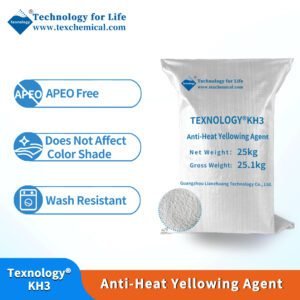
At the production level, Texnology®️-KH3 nylon anti-heat yellowing finishing agent offers strong process compatibility. It adapts to standard pad-dry processes and can be applied during both pre-setting and post-setting stages without any modifications to existing production lines. This nylon anti-heat yellowing agent works equally well on pure nylon fabrics and nylon/elastane blends. It preserves the dimensional stability of stretch fabrics while solving the common yellowing problem in nylon/spandex materials. Consequently, it suits a wide range of products, from activewear to underwear.
Conclusion: A Strategic Investment for Fabric Mills
As consumer expectations for fabric quality and aesthetics continue to rise, high-temperature yellowing remains a critical technical challenge for fabric mills seeking product upgrades. Rather than reworking defective goods after heat-setting, forward-thinking fabric mills can proactively apply a nylon anti-heat yellowing agent during finishing. This approach effectively eliminates quality risks from high-temperature processing, stabilizes the visual appearance of light-colored and bleached nylon fabrics, and helps fabric mills develop more competitive high-quality textiles that stand out in niche markets.