
Color fastness is a key quality measure in textile dyeing and printing. However, mills often face a common problem. On cellulose fibers, reactive dyes and direct dyes can fade when washed. They can also stain when rubbed. These issues lower fabric grade and hurt the user experience.
Meanwhile, a high-concentration formaldehyde-free fixing agent offers a practical answer. It helps mills improve fastness, meet green rules, and protect product safety. In addition, environmental policy is getting stricter. The new wastewater discharge standard for textile dyeing and finishing now applies. As a result, traditional formaldehyde fixing agents are leaving the market. Therefore, high-concentration formaldehyde-free fixing agents are no longer optional for dyeing and printing mills. They are essential.
How Does High-Concentration Formaldehyde-Free Fixing Agent Work?
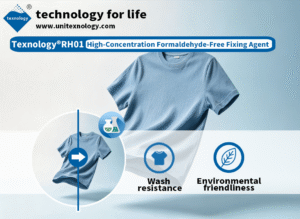
Technically, this fixing agent works in several ways. First, its cationic groups bind to anionic groups on the dye. As a result, this electrostatic bond helps the dye attach to the fiber. Second, its reactive groups crosslink with hydroxyl groups on both dye molecules and cellulose molecules. Consequently, this crosslinking forms a strong bond. Third, it forms a protective film on the fiber surface. In turn, this film helps keep dye from washing out. Finally, Texnology®RH01 High-Concentration Formaldehyde-Free Fixing Agent uses a high-molecular cationic polymer design. Overall, through these combined mechanisms, it delivers strong fixing performance.
Core Advantages of Texnology®️-RH01 High-Concentration Formaldehyde-Free Fixing Agent
Texnology® RH01 High-Concentration Formaldehyde-Free Fixing Agent: Four Core Advantages
First and foremost, Texnology® RH01 High-Concentration Formaldehyde-Free Fixing Agent is truly formaldehyde-free. It contains neither free formaldehyde nor bound formaldehyde. Therefore, treated fabric carries no risk of aldehyde pollution. As a result, it acts as a passport for both export and domestic sales, helping meet increasingly strict limits on textile formaldehyde content.
Second, it improves color fastness across the board. Specifically, it raises washing fastness and dry/wet rubbing fastness. Moreover, it boosts rubbing fastness on medium and dark shades. More importantly, it does not affect vividness, shade, or hand feel—a key benefit for brand fabrics that value both color and touch.
Third, however, it preserves hydrophilicity. Unlike many traditional fixing agents, Texnology® RH01 High-Concentration Formaldehyde-Free Fixing Agent allows treated fabric to maintain good hydrophilic performance, supporting later processing and wearing comfort. This clearly sets it apart.
Fourth, it offers high concentration and cost efficiency. Texnology® RH01 High-Concentration Formaldehyde-Free Fixing Agent is supplied as a high-concentration product, and mills can dilute it 1:3–5 with water. Consequently, it lowers storage and transport costs while giving fabric manufacturers flexible application options.
In short, Texnology® RH01 High-Concentration Formaldehyde-Free Fixing Agent combines formaldehyde-free safety, all-round fastness improvement, hydrophilic performance, and cost-effective high concentration.
Where Do Dyeing and Printing Mills Use Texnology®️-RH01?
Texnology®️-RH01 High-Concentration Formaldehyde-Free Fixing Agent suits many cellulose fibers. These include pure cotton, linen, and viscose. It also works on blends with polyester and spandex. It performs well in knit, woven, and package yarn dyeing. Therefore, dyeing and printing mills can use it across diverse production lines.
As environmental rules keep tightening, demand for high-concentration formaldehyde-free fixing agent keeps growing. Consumers also pay more attention to textile safety. Therefore, choose a fixing solution that combines eco-friendliness, high efficiency, and economic value. This choice upgrades fabric quality. More importantly, it helps dyeing and printing mills follow the green transition.