[Insert Image/Video Here: Woven fabric undergoing flex abrasion testing]
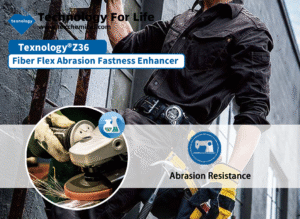
Textile dyeing and printing mills often finish heat setting and softening with no trouble. However, lab tests frequently show flex abrasion or seam slippage failures. Consequently, many dyeing and printing mills now add a fiber flex abrasion fastness enhancer to their production lines. For example, Texnology®Z36 fiber flex abrasion fastness enhancer offers a reliable solution for these woven fabric orders.
Why Do Dyeing and Printing Mills Face Flex Abrasion Failures?
Woven fabrics face dynamic bending and rubbing in real use. As a result, fibers break, yarns slip, and seams open. These problems often appear after softeners or alkali reduction loosen the yarn structure. Standard finishing can pass colorfastness tests. Nevertheless, flex abrasion and seam slippage tests still fail.
Workwear elbows fuzz after repeated bending. Meanwhile, tents and canopies suffer yarn slippage after rubbing. Furthermore, Lyocell and viscose linings often fail seam slippage tests. Polyester fabrics also lose mechanical strength after amino silicone softening. Therefore, orders get stuck at testing, leading to rework and delivery delays.
What Makes Fiber Flex Abrasion Fastness Enhancer Different?
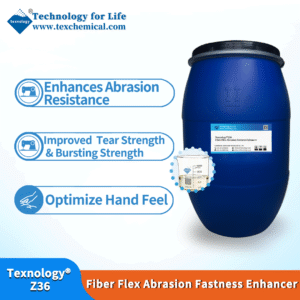
Some factories try crosslinkers first. However, crosslinkers make the hand feel firm. Moreover, they fail to solve fiber breakage and yarn slippage. Mills actually need one product that stabilizes multiple indicators. Texnology®Z36 fiber flex abrasion fastness enhancer meets this need. It uses a weak cationic modified polyethylene copolymer system to reinforce fabrics from the inside.
Three Reinforcement Mechanisms
1. Yarn Locking
First, the polymer chains penetrate fiber gaps inside yarns. Then, heat curing forms a stable hydrogen-bond network. This network locks loose fibers. Therefore, it stops yarn slip and seam slippage caused by excess silicone or over-reduction.
2. Flexible Film Formation
Second, the enhancer forms a thin, flexible film on fiber surfaces. This film does not harden or board the fabric. Instead, it absorbs shear stress during repeated bending. Thus, fibers cut each other less, which slows down fuzzing and holes.
3. Overall Strength Support
Finally, the formula builds an invisible support network. This network improves tear and bursting strength at the same time. Furthermore, it improves sewing performance and reduces needle-hole cracking. Additionally, it wraps surface unfixed dye to help improve rubbing colorfastness.
Six Core Advantages for Bulk Production
[Insert Image/Video Here: Fabric sample treated with Texnology®Z36 fiber flex abrasion fastness enhancer]
Multi-indicator improvement: Improves flex abrasion, tear strength, and bursting strength in one step. It also suppresses yarn slippage and seam slippage.
Low-yellowing formula: Friendly to light and bleached fabrics. Heat curing causes very little yellowing.
Controllable hand feel: Leaves fabrics smooth and elastic. It keeps the original fabric style without hardening or boarding.
Rework support: Mills can pad and rework nonconforming finished fabrics. Consequently, this reduces scrap loss.
Flexible compatibility: Runs smoothly in one bath with hydrophilic and resin systems.
Eco compliance: It is formaldehyde-free and water-based. Moreover, it meets OEKO-TEX, REACH, and other export supply chain requirements.
Which Fabrics Benefit Most?
Texnology®Z36 fiber flex abrasion fastness enhancer works best on woven fabrics. These include cotton, polyester-cotton, polyester, viscose, modal, lyocell, and nylon-polyester blends. Specifically, it excels in the following applications:
Workwear, protective workwear, and training wear fabrics with high-frequency bending at elbows and knees.
Tents, canopies, backpacks, bags, and other outdoor fabrics.
Viscose and lyocell woven linings, a high-risk category for seam slippage.
Alkali-reduced polyester and silicone-softened fabrics that need rework.
Conclusion
Flex abrasion, low strength, and yarn slippage often block workwear and outdoor orders. Texnology®Z36 fiber flex abrasion fastness enhancer solves dynamic rubbing damage, yarn slippage, and strength loss. It supports bulk heat-setting processing and finished-goods rework. Because it offers low yellowing and eco compliance, dyeing and printing mills can reduce complex additive trials. Ultimately, it eases workshop workload and protects order delivery.
About Us
Guangzhou Lianzhuang Technology Co., Ltd. focuses on the R&D and production of textile functional finishing agents. We strive to add diverse functional value to textiles and advance finishing technology. Our company has a professional development team and a scientific quality management system. We sincerely provide textile dyeing, printing, and garment companies with various efficient textile functional solutions.