
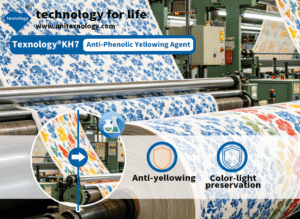
For dyeing and printing mills, the anti-phenolic yellowing agent is a critical tool to protect white and light‑shade nylon fabrics from unsightly discoloration. Without this treatment, nylon’s inherent chemistry makes it vulnerable—but the right agent can shut down the reaction before it starts.
Nylon (polyamide) fibers contain many amino (–NH₂) and imino (–NH–) groups along their molecular chains. These groups are basic and readily react with acidic or oxidizing substances. When nylon fabrics contact BHT (2,6‑di‑tert‑butyl‑4‑methylphenol) from packaging materials, BHT converts into nitro compounds in the presence of NOx gases. Those nitro compounds then react with the amino groups on nylon to form yellow quinoid substances. This is the core chemical mechanism behind phenolic yellowing.
Texnology®️‑KH7 anti‑phenolic yellowing agent is a specialized blend of anionic compounds. Its mode of action is straightforward: the anionic active components electrostatically bind to the protonated amino groups (–NH₃⁺) on nylon fibers. This binding effectively blocks these reactive sites. Once blocked, the amino groups can no longer participate in yellowing reactions with BHT or other pollutants. This “root‑cause” protection means that the anti‑phenolic yellowing agent simultaneously guards against multiple triggers—sunlight, NOx/SOx exhaust fumes, lignin, and BHT—because all of them ultimately need free amino groups as the entry point for yellowing.
How Does the Anti‑Phenolic Yellowing Agent Achieve Such Reliable Results?
By chemically sealing the amino functional groups, Texnology®️‑KH7 anti‑phenolic yellowing agent breaks the yellowing reaction chain at its source. After treatment, nylon fabrics consistently score 4‑5 on standard phenolic yellowing tests—a level that meets the strict requirements of most international brands. For white and extremely light shades of nylon and nylon/spandex blends, mills can achieve ideal protection at recommended dosages: 20‑40 g/L for pad applications, or 2‑4 g/L for exhaust processes.
Why Dyeing Mills Prefer This Anti‑Phenolic Yellowing Agent for Export Orders
Texnology®️‑KH7 anti‑phenolic yellowing agent is an anionic specialty compound that contains no banned or restricted hazardous substances. It fully complies with international environmental standards. This gives dyeing and printing mills confidence when fulfilling export orders—they secure both anti‑yellowing performance and regulatory compliance. Moreover, this anti‑phenolic yellowing agent works perfectly in a one‑bath process with fluorescent whitening agents. That means mills can combine whitening and anti‑yellowing protection in a single step, significantly boosting production efficiency.
Practical Benefits for Your Production Line
Stable grade 4‑5 even under rigorous phenolic yellowing tests.
Versatile protection against sunlight, exhaust gases, and packaging contaminants.
Eco‑friendly formulation – no restricted chemicals, safe for global brands.
Process flexibility – pad or exhaust, and compatible with optical brighteners.
For any dyeing and printing mill handling white or pastel nylon, investing in a proven anti‑phenolic yellowing agent like Texnology®️‑KH7 anti‑phenolic yellowing agent is a smart move. It eliminates the risk of yellowing‑related rejects, reduces rework, and ensures your fabrics leave the factory looking as bright as your customers expect. Many leading textile mills have already adopted this solution to streamline their quality control and meet the growing demand for high‑grade, yellowing‑free nylon products.