
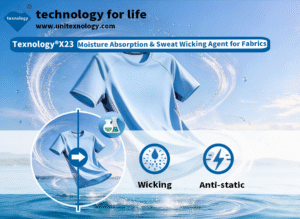
Summer sportswear often fails after sweat: it clings, feels hot, and loses breathability. Polyester, nylon, and other synthetic fibers dominate sportswear and outdoor gear. However, their large molecules lack hydrophilic groups and have low moisture regain. As a result, sweat cannot adsorb, transfer, and evaporate quickly. Comfort drops fast. As a functional finishing auxiliary manufacturer, Lianzhuang Technology offers Texnology®️X23 fabric moisture-wicking agent. This product helps fabric mills upgrade synthetic fabrics with hydrophilic performance.
Why Do Synthetic Fabrics Feel Hot and Sticky?
From a textile finishing view, comfort involves more than hand feel. It also depends on how sweat moves through fabric: absorption, moisture transfer, diffusion, and evaporation. Hydrophobic fiber surfaces resist wetting. Therefore, sweat stays between skin and fabric. This creates a sticky feel. Moreover, synthetic fibers build static and hold stains. As a result, fabric mills improve surface wetting and moisture transfer through hydrophilic finishing. They do not change the main fiber performance.
How Does Texnology®️X23 Fabric Moisture-Wicking Agent Work?
Texnology®️X23 fabric moisture-wicking agent from Zhuangjie Chemical suits polyester and its blends, nylon, acetate, and spandex. After finishing, fiber surfaces become more hydrophilic. This helps sweat and moisture move away from skin. Then they spread and evaporate on the outer fabric layer. As a result, synthetic fabrics feel drier and less sticky. They also feel less hot. For running, cycling, fitness, and hiking, moisture absorption and quick drying directly affect wearer experience.
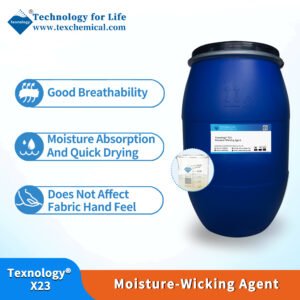
What Multiple Benefits Does Texnology®️X23 Fabric Moisture-Wicking Agent Offer?
Texnology®️X23 fabric moisture-wicking agent does more than moisture management. It also gives fabrics good antistatic and soil-release performance. This reduces static cling and stain residue common in synthetic fabrics. In addition, Texnology®️X23 fabric moisture-wicking agent has low yellowing. It barely affects shade. Moreover, finished fabrics feel soft and smooth. For synthetic fabrics that do not require very soft hand, fabric mills can skip extra softener. This helps fabric mills optimize auxiliary combinations and simplify processes. For sportswear fabrics, this balance supports function, appearance, and hand.
How Do Fabric Mills Apply Texnology®️X23 Fabric Moisture-Wicking Agent?
Texnology®️X23 fabric moisture-wicking agent offers flexible application. The exhaust process suits yarn, loose fiber, or garment finishing. The padding process suits continuous fabric production. These two processes cover different production scenarios. Therefore, fabric mills can choose based on equipment and order requirements.
Conclusion
Comfort is a core competitive advantage in sportswear. Texnology®️X23 fabric moisture-wicking agent focuses on moisture absorption and quick drying. It also supports antistatic performance, soil release, hand improvement, and shade protection. Therefore, fabric mills can develop functional sportswear fabrics with stronger market appeal.