
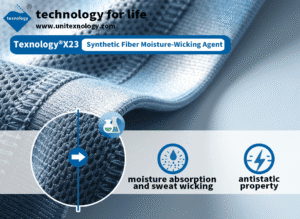
Wearing synthetic fabrics like polyester and nylon in summer can be uncomfortable. Sweat makes them stick to your skin, feeling stuffy and clammy. Friction even causes static, attracting dust and clinging to your legs. These fabrics are durable and shape-retaining, but their natural hydrophobicity is a major drawback. For fabric mills and apparel brands, improving comfort and adding value has been a tough challenge. However, a synthetic fiber moisture-wicking agent offers a solution to make synthetic fabrics truly moisture-wicking, not just surface-wet.
Many mills rely on simple softening washes. This only improves hand feel temporarily. After a few washes, the effect fades. To truly enhance comfort, functional finishing agents are essential. Today, we share an efficient moisture-wicking solution tailored for synthetic fabrics.
Why Do Synthetic Fabrics Trap Sweat and Build Static?
Polyester and nylon have dense molecular structures and lack hydrophilic groups. This creates two unavoidable problems.
First, the fabric does not absorb sweat. When you sweat, moisture stays between your skin and the fabric. In hot weather, this makes the garment feel damp and sticky. The wearing experience is poor for sports and daily commuting.
Second, oil and sweat residues cause static. Body oils and sweat remain on the fabric surface. They attract dirt and dust. Friction generates charge that cannot dissipate. As a result, static builds up. The fabric clings to your legs, attracts dust, and even produces sparks.
Core Principle: How the Synthetic Fiber Moisture-Wicking Agent Works
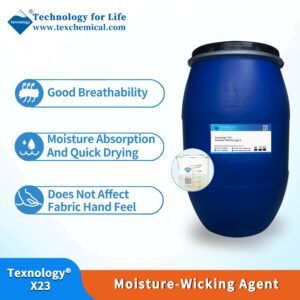
Take Texnology®X23 Synthetic Fiber Moisture-Wicking Agent as an example. This synthetic fiber moisture-wicking agent contains a polyether-polyester compound as its active ingredient. During the high-temperature setting process, it cures on each synthetic fiber surface. It forms a durable hydrophilic film that provides three benefits simultaneously.
1. Rapid spreading and wetting
The outer layer of the film has many hydrophilic groups. These reduce the surface tension of water. When sweat lands on the fabric, it does not bead up and roll off. Instead, it spreads and wets the fabric instantly.
2. Capillary wicking for faster drying
The film creates capillary channels along the fiber gaps. These channels quickly transport moisture from your skin to the outer fabric layer. This expands the evaporation area, so moisture does not stay trapped.
3. Static dissipation to prevent cling
The hydrophilic film also has conductive properties. It can quickly release static electricity generated by friction. This prevents static buildup, cling, and dust attraction from the start.
Together, these actions form a complete cycle: absorb moisture, wick it away, and dry quickly. This solves the three common issues of synthetic fabrics: stuffiness, cling, and static.
Production Advantages of Texnology®X23 Synthetic Fiber Moisture-Wicking Agent
After finishing with this synthetic fiber moisture-wicking agent, synthetic fabrics gain continuous hydrophilic capillary channels on the fiber surface. This physically compensates for the lack of hydrophilic groups in polyester and nylon. Even after repeated washing and wearing, the wicking performance remains strong. Users no longer experience the discomfort of sweaty, sticky garments. In addition, the agent provides a mild easy-clean effect. One fabric can deliver multiple comfort functions.
Applicable Fabrics, Products, and Processing for Texnology®X23 Synthetic Fiber Moisture-Wicking Agent
Applicable materials
Texnology®X23 Synthetic Fiber Moisture-Wicking Agent works on 100% polyester, polyester-cotton blends (T/C), nylon (polyamide), acetate, and various synthetic fiber blends.
Applicable end products
It is suitable for sportswear, outdoor jackets, underwear, casual shirts, and home bedding made from synthetic fabrics.
Processing method
Use the padding method during the setting step after dyeing. The process is simple and fits existing production lines without extra equipment modifications.
Conclusion: Functional Finishing Is the Core Path to Differentiate Synthetic Fabrics
The synthetic fabrics market is highly homogeneous. Simply changing colors or styles is not enough to escape price wars. Consumers now pay more attention to wearing comfort.
After functional finishing, synthetic fabrics can offer lasting moisture-wicking, anti-static, and easy-cleaning properties. This directly addresses the pain points of summer wear: sticky, clammy, and static-prone clothing. It boosts consumer satisfaction and differentiates your products from ordinary synthetic fabrics. Ultimately, it increases the value of your fabrics and garments.