
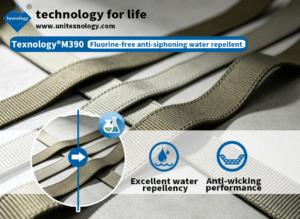
As PFAS regulations tighten, more webbing manufacturers look for a fluorine-free anti-wicking waterproofing agent. This article explains how Texnology®️-M390, a fluorine-free anti-wicking waterproofing agent, helps webbing manufacturers improve fabric performance and pass anti-wicking tests.
What Is Anti-Wicking Finishing?
Wicking is a simple physical effect. Water climbs along fiber gaps from low points to high points. For webbing, shoelaces, and similar products, anti-wicking performance directly affects the end user’s experience. If a shoelace wicks, rain or sweat can seep into the shoe. If bag webbing fails anti-wicking tests, it can show obvious water transfer when wet.
Texnology®️-M390 Fluorine-free anti-siphoning water repellent targets synthetic fibers and their blends. It provides waterproofing and anti-wicking finishing. Unlike traditional fluorine-containing water repellents, it contains no PFOA, PFOS, or other regulated substances. Therefore, it meets international environmental export standards.
Why Do Webbing Manufacturers Choose a Fluorine-Free Anti-Wicking Waterproofing Agent?
As the EU REACH regulation moves toward limiting PFHxA substances, fluorine-containing water repellents face stricter supervision. For export-focused webbing manufacturers, choosing a fluorine-free anti-wicking waterproofing agent is not just an environmental choice. It is also a necessary step to enter international markets smoothly.
Texnology®️-Fluorine-free anti-siphoning water repellent delivers three core benefits in practical use. First, it provides excellent water repellency. It effectively resists rain and other water-based stains. Second, it maintains fabric breathability. This keeps finished products more comfortable to wear. Third, it has minimal impact on fabric hand feel and color. This matters a lot for webbing products that depend on appearance.
Case Study: From Repeated Trials to First-Time Approval
An apparel accessories manufacturer in Jiangsu once struggled with unstable anti-wicking finishing for a batch of webbing and shoelaces. The factory’s polyester webbing needed to meet a customer requirement: in a static anti-wicking test, water climb must not exceed 1 cm after 2 hours. However, after many adjustments to water repellent dosage and process parameters, the pass rate remained poor.
With support from Lianzhuang Chemical’s technical team, the factory adopted a targeted fluorine-free anti-wicking finishing solution. The factory treated its webbing with Texnology®️-Fluorine-free anti-siphoning water repellent. The webbing performed well. It passed customer acceptance in one run. The factory then restarted mass production. As a result, it solved a long-standing quality instability problem.
This case shows a clear point. When webbing manufacturers choose the right fluorine-free anti-wicking waterproofing agent and use proper process parameters, they can achieve stable anti-wicking results without fluorine-containing additives.
Conclusion: A Smarter Choice for Webbing Manufacturers
Environmental regulations keep getting stricter. Therefore, a fluorine-free anti-wicking waterproofing agent is becoming a wise choice for more webbing manufacturers. It helps them improve product competitiveness. It also helps them meet PFAS requirements and win in international markets.