
TEXNOLOGY®C302 degreaser, TEXNOLOGY®RH12 high-temperature leveling agent, and TEXNOLOGY®M620 fluorine-free water repellent help solve key problems in polyester knitted fabric processing. Polyester knitted fabric offers excellent elasticity and wash durability. So it is widely used in sportswear, underwear, and outdoor clothing. However, dyeing mills face many challenges. These include stubborn oil stains, color shading, poor water repellency, the conflict between water repellency and hand feel, and stricter environmental regulations. Choosing efficient and stable auxiliaries like these three is the key to raising first-pass rates and lowering costs.
Common problems in dyeing and finishing
- Pretreatment
Polyester knitted fabric contains weaving oils. Ordinary degreasers cannot emulsify them completely. As a result, stains and color patches appear after dyeing. - Dyeing
Disperse dyes exhaust too quickly at high temperatures. This easily causes color shading and shade differences. Different dye structures have different exhaustion rates. This creates batch‑to‑batch variation. - Finishing
Traditional water repellents are mostly fluorinated. Their environmental use is restricted. They also cause roller sticking and harm fabric hand feel. Moreover, their water repellency and anti‑wicking performance are often insufficient.
Lianzhuang solutions and product advantages
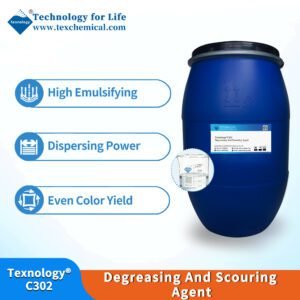
Pretreatment: TEXNOLOGY®C302 degreaser
Application: Degreasing and washing of cotton, linen, cellulosic fibers, and their blends.
Problem it solves: Low removal of stubborn mineral oils, silicone oils, and waxes. This hurts dyeing quality.
Product advantages:
TEXNOLOGY®C302 is a mixture of isotridecanol ethoxylates. It comes in high concentration. You can dilute it with cold water. This reduces transport and storage costs.
It gives low foam, fast penetration, and strong emulsification to strip all kinds of stubborn oils.
It removes over 95% of silicone oil from spandex. After treatment, residual oil content on fabric stays below 0.8%. This creates a clean base for level dyeing.
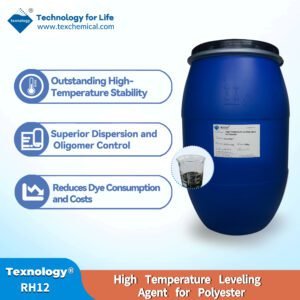
Dyeing: TEXNOLOGY®RH12 high-temperature leveling agent
Application: Polyester and other synthetic fibers and fabrics.
Problem it solves: Dyes exhaust too fast or unevenly, causing color shading and shade differences. Traditional leveling agents foam easily, which leads to fabric tangling.
Product advantages:
TEXNOLOGY®RH12 forms complexes with dyes. This slows down the exhaustion rate and prevents color shading.
At high temperatures, it releases dyes slowly. This promotes even dyeing. It helps different dye structures exhaust at similar rates. As a result, it reduces shade differences and raises first‑pass rates.
It has a low‑foam design, so it avoids fabric tangling. It does not affect color shade, hand feel, or color fastness. Safe and reliable.
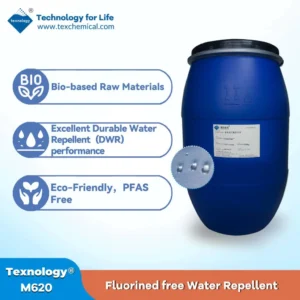
Finishing: TEXNOLOGY®M620 fluorine‑free water repellent
Application: Webbing, shoe materials, and other polyester knitted fabrics.
Problem it solves: Fluorinated repellents face environmental restrictions. Acrylic‑based ones give a hard hand feel and cause roller sticking. Their anti‑wicking and alcohol resistance are poor.
Product advantages:
TEXNOLOGY®M620 is a polyurethane dispersion. It processes stably and hardly causes roller sticking. So it works well for continuous production.
It does not affect the fabric’s original hand feel. The fabric stays soft and comfortable.
It contains no fluorine and no APEO. It meets environmental regulations.
Compared to standard acrylic‑based repellents, it gives much better water repellency. You see a clear water bounce effect.
It also offers excellent anti‑wicking performance. This effectively stops water from penetrating.
Conclusion
To improve the quality of polyester knitted fabric, you need a systematic approach: clean pretreatment, even dyeing, and stable finishing. TEXNOLOGY®C302 degreaser removes silicone oils and stubborn stains. TEXNOLOGY®RH12 leveling agent ensures uniform dyeing. TEXNOLOGY®M620 fluorine‑free water repellent balances eco‑compliance with excellent water repellency. Together, these three products help dyeing mills lower rework rates, raise fabric quality, and achieve efficient, green production.
