
Do you face these problems with waterproofing plus coating?
Brands demand more today. Sports apparel, outdoor jackets, workwear, tents, umbrella fabrics – all need “Cationic fluorine-free water repellent + anionic resin”
So fabric must have excellent water repellency. Then on top of that, it needs a PU or PA coating. That coating adds windproofing, light blocking, and a crisp feel.
But here is the trouble.
The common nightmares
You pick a great water repellent. Then you add it to the coating paste. Suddenly, sediment appears at the bottom of the trough. Oil blooms. Or the paste separates and clumps. A whole batch goes to waste.
You try different repellents. You change the ratios. Still they fight each other. So you change the whole process. You waterproof first, then coat later. That means one extra pass through the stenter. Each meter costs you an extra 20 cents. Then you finally rush the delivery. But the customer sends back a test report. High fluorine content. The whole shipment fails customs. You lose money. You lose the goods.
Some salespeople say you need a cationic repellent for good performance. But most coating pastes in your mill – PU glue or AC glue – are anionic. Mix them, and trouble starts immediately.
Even if you manage to make the fabric, it feels stiff. It yellows easily. The customer just touches it and returns the whole order. No chance to fix it.
So what is the real problem?
These issues are not about bad fabric. They are not about your skill. They are about choosing the wrong type of water repellent.
Why does a repellent fight with anionic paste?
This question troubles many veteran mill technicians.
Many water repellents are cationic. Why? Because cationic types give better absorption and film formation.
But here is the problem. Most coating pastes for waterproof finishing – whether PU or AC – are anionic.
Now think about this. A cationic repellent is positive. Anionic paste is negative. Mix them together, and ionic conflict happens. You get sediment, oil blooming, separation, and roll sticking. It is like pouring water into hot oil. The batch simply fails.
Even without a coating step, many leftover dyes and auxiliaries are anionic. When a regular cationic repellent meets those leftovers, the bath becomes unstable. As a result, you get water repellent spots and other defects.
The old, costly fix
In traditional methods, technicians solve this by doing waterproofing first. Then they do coating separately. Two separate processes. No more fighting. But costs jump. You add an extra stenter pass. You burn extra gas. You spend extra labor and time. At 2500 RMB per shift for stenter processing, you lose several thousand RMB each day.
The real key
So what matters most for one‑bath waterproof coating? The answer is simple. Your water repellent must be “neutral” enough. It must not react with the coating paste or other auxiliaries.
A better solution: Texnology®M360N Non-ionic fluorine-free water repellent
Guangzhou Lianzhuang Technology Co., Ltd. developed Texnology®M360N to solve these mill problems. This product is a waterborne, fluorine‑free, nonionic water repellent.
What makes it different?
It is nonionic. Three consecutive sentences starting with the same word (“It”):It does not fight with anionic pastes. It does not cause sediment or oil blooming. It keeps your bath stable from start to finish.
Key advantages of Texnology®M360N Non-ionic fluorine-free water repellent
First, you can mix it directly with anionic coating pastes like PU glue or AC glue. One bath does both waterproofing and coating. No extra stenter pass.
Second, it has excellent interference resistance. Even if the bath contains anionic dyeing leftovers from previous steps, the product stays stable. Even if you need to add crosslinkers, thickeners, or anti‑static agents, Texnology®M360N will not easily sediment or oil bloom. Therefore, it greatly lowers the risk of roll sticking.
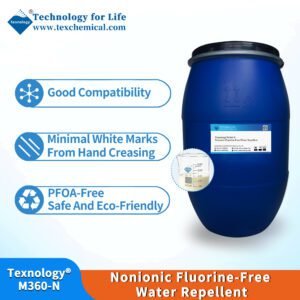
Third, it is fluorine‑free. It contains no PFOA, no PFOS, and no APEO. So it meets the strict PFAS regulations in Europe and America. This helps textile exporters pass customs smoothly.
What fabrics can you use it on?
Finally, Texnology®M360N works on many materials. For example, polyester, cotton, nylon, and their blends. It also suits outdoor wear, workwear, luggage fabrics, tents, and umbrella cloths. In short, any product that needs both water repellency and a coating finish.
Product summary
Texnology®M360N has five core features.
First, its nonionic structure gives full compatibility with anionic and cationic pastes. No emulsion breaking. No roll sticking.
Second, it resists acids, alkalis, hard water, and electrolytes. This improves process tolerance. It also reduces machine stops and rework.
Third, it contains no banned substances. It fully complies with French and EU PFAS bans.
Fourth, it works on many fibers. One product replaces many. You lower inventory pressure.
Finally, all these features lead to one result. You can directly replace your existing repellent with Texnology®M360N. You do not need to change your current formula system. Then you solve three core problems: poor compatibility, failing water repellency, and non‑compliance with environmental rules.
In short, do you want a water repellent that works with your coating paste in one bath, saves you a stenter pass, and meets global PFAS bans?
Then try Texnology®M360N. It is worth your attention.
