
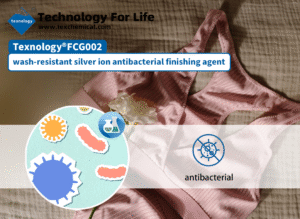
Many fabric brands face the same challenge. New antibacterial products pass lab tests. However, after consumers wash them about a dozen times, socks turn musty. Towels feel sticky. Antibacterial performance drops sharply. Then after-sales complaints and reputation loss follow.
For dyeing and printing mills, this issue is especially costly. Most “one-wash antibacterial” fabrics rely on additives. These additives only stick to fiber surfaces. As a result, water washing and mechanical rubbing easily wash them away.
The additive system also lacks stability. Therefore, bulk production often shows uneven application and poor end-user experience. To solve this industry pain point, Zhanjie Chemical developed the Texnology®FCG002 wash-resistant silver ion antibacterial finishing agent. It is designed for real consumer washing scenarios. This product targets the industry problem of antibacterial failure after washing.
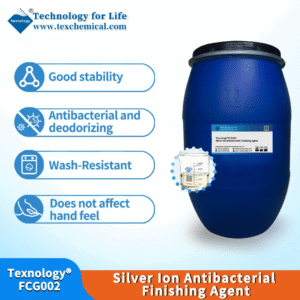
How the Wash-Resistant Silver Ion Antibacterial Finishing Agent Builds Wash-Durable Protection
Ordinary antibacterial additives mostly rely on simple surface contact. They attach to fiber surfaces. However, they have no strong grip. Therefore, water, rubbing, and soap easily wash away the active ingredients. As a result, antibacterial performance falls fast.
In contrast, Texnology®FCG002 wash-resistant silver ion antibacterial finishing agent uses tiny silver particles. It moves beyond simple surface contact. Its active parts anchor evenly onto the fabric. Under sweat and moisture, the agent releases silver ions slowly.
Then, the silver ions break germ cell walls. They also shut down proteins that germs need to live. As a result, the product delivers wide antibacterial and odor-control performance. It works against common harmful bacteria on close-to-skin fabrics. Examples include Staphylococcus aureus, Escherichia coli, and Candida albicans.
Moreover, it stops microorganisms from growing in human sweat. This reduces bad odor. In addition, it limits the loss of active parts during washing. Therefore, it improves the industry pain point of “wash deactivation” in textile antibacterial finishing.
Close-to-Skin Underwear Case: Multiple Benefits in Real Use
Close-to-skin underwear touches sweat and body fluids for long periods. It also goes through frequent machine washing. Many underwear products show good antibacterial effects at first. However, after repeated washing, antibacterial performance fails quickly. Wearers then feel damp and notice odor.
Texnology®FCG002 wash-resistant silver ion antibacterial finishing agent solves this problem through post-finishing. Its anchored active parts keep effective antibacterial ability after many home washes. They stop bacterial growth and odor. The raw materials are safe and cause low irritation. Therefore, the product fits the contact needs of private close-to-skin fabrics. It balances wearing comfort and function.
In addition, the agent does not change the texture or look of the underwear fabric. It is colorless and clear. Therefore, it does not cause yellowing or color change after finishing. Elastic fabrics keep their softness and stretch. Close-to-skin hand feel remains intact.
The process compatibility is strong. For example, mills can process common underwear fabrics such as cotton, modal, and nylon. The agent helps brands build antibacterial products that truly withstand repeated washing. It also helps them escape the marketing trap of “label-only antibacterial” claims.
Why the Wash-Resistant Silver Ion Antibacterial Finishing Agent Supports Stable Bulk Production
Texnology®FCG002 wash-resistant silver ion antibacterial finishing agent works well on many fabrics. It fits pure cotton, blends, chemical fibers, nonwovens, and leather. It is compatible with three mainstream dyeing and finishing processes. These include padding, exhaustion, and spraying.
Therefore, dyeing and printing mills can use it flexibly. It works for towels, close-to-skin apparel, medical fabrics, and home textiles.
The additive system offers good stability. The bath resists clumping and settling. During bulk processing, antibacterial parts spread evenly across the fabric surface. As a result, this reduces color differences and local functional failures.
Mills do not need to change additive types often. They also do not need to greatly adjust existing line settings. One agent can support multiple product lines. Therefore, it simplifies inventory management and shortens testing cycles. It also helps factories reduce rework. Finally, it helps them achieve efficient, stable mass production.
Guangzhou Lianzhuang Technology Co., Ltd. focuses on the R&D and production of textile functional finishing agents. We commit to giving textiles richer functional value. We also commit to advancing post-finishing technology.
Our company has a professional technical team. We also have a scientific quality management system. In short, we sincerely provide dyeing and printing mills with multiple efficient textile functional solutions.