
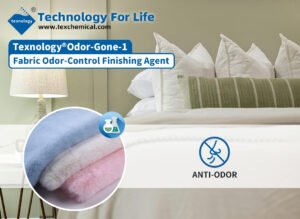
Socks smell after one day. Towels turn sour over time. Bed sheets and quilts often hold unexplained odors. These daily problems now shape how consumers choose textiles. For dyeing and finishing plants, adding odor-control function raises product value. It also meets market demand for healthier, more comfortable textiles. A Fabric Odor-Control Finishing Agent makes this possible.
What Causes Odors, and How Does a Fabric Odor-Control Finishing Agent Help?
Odors come from many sources. Sweat itself does not smell strong. However, bacteria on the skin break sweat down. This produces ammonia, acetic acid, isovaleric acid, and other irritating substances. In addition, formaldehyde and xylene may remain in textiles or adsorb onto fibers from the environment. Most odor molecules are small compounds. They volatilize easily, and human smell detects them quickly.
Texnology®Odor-Gone-1 Fabric Odor-Control Finishing Agent from Lianzhuang Technology captures and adsorbs odor molecules through active ingredients. It provides broad-spectrum deodorizing and odor-preventing effects, effectively removes six major odors: ammonia, trimethylamine, formaldehyde, xylene, acetic acid, and isovaleric acid. The active components form an adsorbent functional layer on the fiber surface. This layer locks odor molecules in place. As a result, it lowers the concentration of odorous substances in the air.
How Does a Fabric Odor-Control Finishing Agent Work After Washing?
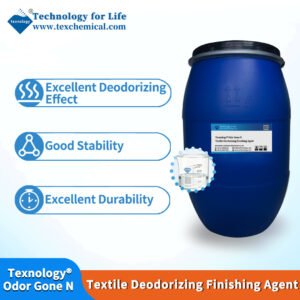
When treated odor-control fabric goes through normal washing, captured odor molecules wash away. The deodorizing function then recovers. Therefore, the finish offers excellent wash durability. Unlike traditional masking methods that cover odor with fragrance, Texnology®Odor-Gone-1 Fabric Odor-Control Finishing Agent uses physical adsorption. It provides broad-spectrum adsorption, wash resistance, and recoverable deodorizing function.
What Advantages Does a Fabric Odor-Control Finishing Agent Bring to Dyeing and Finishing Plants?
Texnology®Odor-Gone-1 Fabric Odor-Control Finishing Agent meets the national standard GB/T 33610.2-2017, “Textiles—Determination of deodorant performance.” It suits cotton, polyester-cotton, nylon, and many other fabrics. After treatment, the fabric shows no negative changes in whiteness, shade, strength, hand feel, or breathability. It preserves the fabric’s original quality.
The pad-cure process fits existing production lines in dyeing and finishing plants. As a result, dyeing and finishing plants can meet odor-control needs for underwear, towels, socks, sheets, carpets, and air filter materials. They can also open new space for differentiated competition in functional textiles. Moreover, dyeing and finishing plants gain a practical route to reusable, odor-free products without major equipment changes.
About Guangzhou Lianzhuang Technology Co., Ltd.
Guangzhou Lianzhuang Technology Co., Ltd. focuses on R&D and production of textile functional finishing agents. Its mission is to give textiles richer functional value and advance finishing technology. A professional development team and a scientific quality management system support the company’s work. Through these strengths, it provides textile dyeing, printing, and garment companies with efficient functional solutions.