
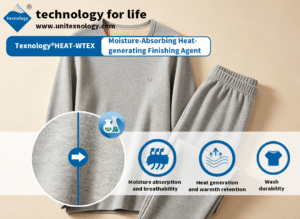
As consumers demand more comfort and function from autumn and winter clothing, moisture-absorbing heat-generating fabrics are entering a fast-growth phase. The right cotton moisture-absorbing heat-generating finishing agent is key to this trend. For fabric mills, it also opens the door to the functional fabric market.
The global market for moisture-absorbing heat-generating high-performance fibers was about USD 6.81 billion in 2025. Analysts project it to reach USD 9.39 billion by 2030, with a CAGR of about 6.64%.
Cotton fabrics feel naturally soft against the skin. They are core materials for thermal underwear, base layers, and other close-to-body garments. However, ordinary cotton has limited moisture-absorbing heat-generating capacity. How can finishing technology give cotton fabrics better warmth? The right cotton moisture-absorbing heat-generating finishing agent is the key solution.
Why Do Cotton Fabrics Need Moisture-Absorbing Heat-Generating Finishing?
Cotton fibers absorb some moisture. However, in cold conditions, ordinary cotton struggles to convert the kinetic energy of water molecules into heat efficiently when the body releases sweat vapor. Therefore, a moisture-absorbing heat-generating finishing agent helps cotton capture that moisture and turn it into useful warmth.
How Does Texnology®️HEAT-WTEX Cotton Moisture-Absorbing Heat-Generating Finishing Agent Work?
Texnology®️HEAT-WTEX cotton moisture-absorbing heat-generating finishing agent uses a cage-like moisture-absorbing heat-generating macromolecular compound as its main component. Fabric mills apply it through pad-dry-cure, immersion, or spray finishing. It works on cotton, viscose, polyester, acrylic, and blends of natural and synthetic fibers. After treatment, cotton fabrics absorb sweat vapor from the body. The vapor condenses into water and releases condensation heat. At the same time, the agent converts the kinetic energy of water molecules into heat. This creates dynamic warmth.
In addition, cotton contains many hydroxyl groups on its cellulose molecular chains. These groups bond well with the hydrophilic groups in Texnology®️HEAT-WTEX cotton moisture-absorbing heat-generating finishing agent. As a result, treated cotton shows higher moisture regain and better moisture diffusion. Heat from moisture absorption spreads more evenly. This reduces local temperature swings and improves comfort. Moreover, the agent gives cotton good wash durability. Treated cotton keeps a stable moisture-absorbing heat-generating effect after repeated washing.
Where Can Fabric Mills Use Texnology®️HEAT-WTEX Cotton Moisture-Absorbing Heat-Generating Finishing Agent?
Treated cotton fabrics work well in thermal underwear, autumn and winter base layers, sports hoodies, pajamas, and home textiles. They keep cotton’s natural soft hand feel. Meanwhile, they deliver dual functions: moisture-absorbing heat generation and moisture-retaining warmth.
For fabric mills, cotton moisture-absorbing heat-generating finishing agent is more than a technical tool for product upgrades. It is also a strong lever for entering the functional fabric market.