
For a long time, static electricity in nonwoven fabrics has troubled fabric mills. That is exactly why a reliable nonwoven antistatic agent matters so much. Synthetic fibers used in nonwovens have high crystallinity and poor moisture absorption. Their specific resistance often exceeds 10¹³ Ω•cm, far above the 10¹⁰ Ω•cm safety threshold. During production, friction and hot-air drying easily generate static charge buildup. This buildup not only reduces processing efficiency but also causes dust attraction, product contamination, and even safety hazards. A high-quality nonwoven antistatic agent can lower surface resistance and improve moisture absorption. As a result, it suppresses static electricity at the source and safeguards both production and product quality.
Two Core Mechanisms of a Nonwoven Antistatic Agent
First, an effective nonwoven antistatic agent forms a conductive continuous film on the material surface. This film imparts certain hygroscopic and ionic properties to the textile, reducing surface resistivity. Consequently, any generated static charge dissipates quickly. Second, it provides a certain lubricity on the textile surface. By lowering the friction coefficient, it inhibits and reduces the generation of static charge. Among available options, Texnology®️‑NW16 nonwoven antistatic agent stands out due to its strong adsorption capacity and excellent processing compatibility. That is why it appears frequently in nonwoven antistatic finishing.
Key Features and Selection Criteria for Texnology®️‑NW16 Nonwoven Antistatic Agent
Texnology®️‑NW16 nonwoven antistatic agent consists of modified organic phosphate ester compounds. Compared with conventional quaternary ammonium salt antistatic agents, it offers broader adaptability. Moreover, it does not cause color loss, color change, or yellowing on fabrics. Additionally, this nonwoven antistatic agent can crosslink and fix onto the fabric through padding or impregnation processes, forming an adsorption layer on the fiber surface. The hydroxyl groups in its molecules form hydrogen bonds with water, which enhances the fabric’s moisture absorption, improves conductivity, and accelerates static charge dissipation.
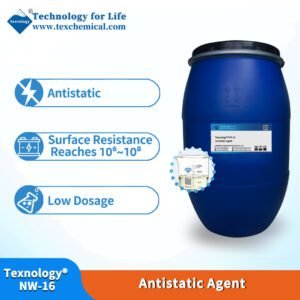
Furthermore, this product works well in a one‑bath process with triple‑resistance finishes. Thus, the fabric gains both antistatic properties and alcohol‑repellent and blood‑repellent effects. This combination proves ideal for medical protective clothing, surgical gowns, masks, industrial dust‑proof suits, and hygiene products—applications that demand both static protection and liquid barrier performance.
Applicable Categories and Process Compatibility of Texnology®️‑NW16 Nonwoven Antistatic Agent
Texnology®️‑NW16 nonwoven antistatic agent finds wide application across nonwovens, underwear, men’s and women’s outerwear, trousers, sportswear, and casual wear. Whether it is the anti‑static functional requirement for industrial nonwovens or the performance upgrade of civil nonwovens in hygiene, medical, and garment fields, antistatic finishing remains a critical step. For fabric mills, choosing a professional nonwoven antistatic agent solves static issues from the very beginning. In doing so, every meter of nonwoven fabric can withstand rigorous quality tests.