
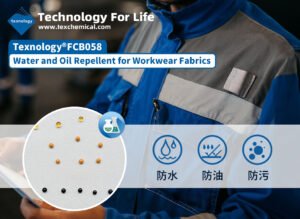
Oilfield workwear often faces crude oil splashes, lubricant drips, and rainwater soaking in turn. Ordinary workwear fabrics block neither oil nor water effectively. Once oil stains penetrate the fibers, washing becomes difficult. Water stains also speed up stain spreading. Therefore, dyeing and finishing plants introduce a Water and Oil Repellent for Workwear Fabrics in finishing. This step fills both the “oil-repellent” and “water-repellent” gaps at the same time.
Why Do Single-Function Finishes Fail Without a Water and Oil Repellent for Workwear Fabrics?
Oil and water penetrate fabrics through different mechanisms. Water has higher surface tension. It mainly wets the fiber surface and seeps down through capillary pores. Oil has lower surface tension. Consequently, it spreads more easily on fiber surfaces and penetrates inside the fibers. This means a water-repellent-only fabric lets water roll off but still lets oil soak in. Meanwhile, an oil-repellent-only fabric blocks oil but may still absorb water. Oilfield workwear needs resistance to both. A single-function finishing agent rarely meets this demand. As a result, dyeing and finishing plants need a dual-function solution.
How Does Water and Oil Repellent for Workwear Fabrics Work?
Texnology®FCB058 Water and Oil Repellent for Workwear Fabrics applies through pad finishing. It forms a dense, low-surface-energy film on the fiber surface. The key lies in its critical surface tension. This value stays far below the surface tension of both water and oil. Therefore, water droplets and oil droplets cannot spread or wet the fabric surface. Their contact angle exceeds 90 degrees. This creates an “oil-water dual repellency” barrier.
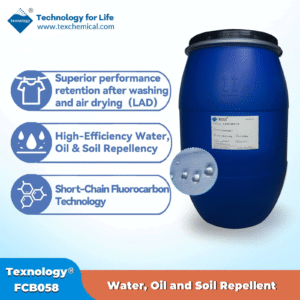
Treated oilfield workwear fabrics keep durable water and oil repellency through washing. Moreover, the finish has little effect on shade or hand feel. Dyeing and finishing plants can complete processing with conventional pad-dry-cure equipment. No production line changes are needed.
Where Do Dyeing and Finishing Plants Overlook Leakage Points?
Sewing threads and needle holes often become “shortcuts” for oil and water penetration. Therefore, dyeing and finishing plants should also treat sewing threads with Texnology®FCB058 Water and Oil Repellent for Workwear Fabrics. This step reduces liquid penetration at needle holes. As a result, the workwear gains more complete triple-protection performance. For dyeing and finishing plants, water and oil repellent finishing must cover not only the fabric but also detail areas. Only then can oilfield workwear achieve stable and efficient protection against oil and water attacks.
About Guangzhou Lianzhuang Technology Co., Ltd.
Guangzhou Lianzhuang Technology Co., Ltd. has focused on R&D and production of textile functional finishing agents for 19 years. Its innovative finishing technologies give textiles richer and more diverse functional value. In addition, a professional development team and a scientific quality management system support its work. Therefore, the company provides textile, dyeing and printing, and garment enterprises with efficient, stable functional solutions that strengthen product competitiveness.