
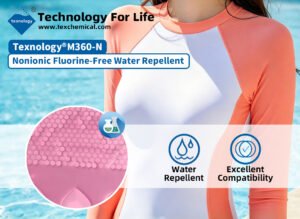
Water-reveal fabrics look plain when dry. Yet patterns appear clearly when the fabric gets wet. More and more swimwear, outdoor apparel, children’s clothing, and beach towels use this effect. For printing plants, the key lies in combining the printing process with a suitable water repellent. A Nonionic Fluorine-Free Water Repellent makes the process stable and keeps patterns sharp.
How Do Printing Plants Create Water-Reveal Effects and Why Does a Nonionic Fluorine-Free Water Repellent Matter?
The principle is simple. When dry, treated and untreated areas look similar. When wet, treated fibers resist water. Water droplets stay on the surface or roll off. Untreated areas absorb water quickly. This dry-wet contrast forms the pattern.
Printing plants often achieve this effect through printing. They mix a water repellent with a thickener to make a repellent printing paste. Then they print one side of the fabric with a patterned screen. Printed areas gain water repellency. Unprinted areas stay hydrophilic. As a result, the pattern appears naturally when water touches the fabric.
Why Do Printing Plants Face Compatibility Problems Without a Nonionic Fluorine-Free Water Repellent?
The process looks simple. However, one hidden problem often appears. Most printing pastes use anionic thickeners. Conventional water repellents are often cationic. When the two mix, opposite charges react. This reaction can break the emulsion, cause separation, or create sediment. Consequently, the printing paste becomes unstable. Water repellency also drops sharply. The dry-wet contrast then weakens or disappears.
Therefore, printing plants need a compatible repellent. A Nonionic Fluorine-Free Water Repellent avoids this charge conflict. It mixes stably with anionic thickeners. Printing plants can prepare the paste according to their formula without worrying about emulsion breakdown or sediment.
How Does This Nonionic Fluorine-Free Water Repellent Work?
Lianzhuang Technology developed Texnology®M360-N Nonionic Fluorine-Free Water Repellent for this printing challenge. Its nonionic nature lets it coexist with anionic thickeners in the printing paste. The agent attaches to the fabric surface with the paste. It then forms a low-surface-tension water-repellent layer on the fibers. Printed areas resist wetting. Unprinted areas absorb water normally. When wet, the contrast becomes clear, and pattern edges stay sharp.
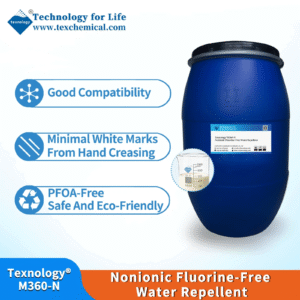
Moreover, this Nonionic Fluorine-Free Water Repellent contains no PFAS. It meets increasingly strict environmental rules and export order requirements. For printing plants, Texnology®M360-N Nonionic Fluorine-Free Water Repellent makes paste preparation more controllable. It also provides a stable process base for developing differentiated water-reveal fabrics. In addition, printing plants can reduce trial-and-error costs and improve production consistency.
About Guangzhou Lianzhuang Technology Co., Ltd.
Guangzhou Lianzhuang Technology Co., Ltd. has focused on R&D and production of textile functional finishing agents for 19 years. Its innovative finishing technologies give textiles richer, more diverse functional value. A professional development team and a scientific quality management system support its work. The company provides textile, dyeing and printing, and garment enterprises with efficient, stable functional solutions that strengthen product competitiveness.