
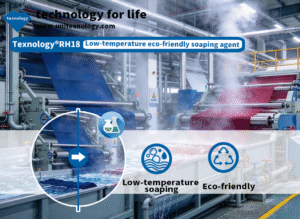
Reactive dyes offer bright colors, full shades, simple operation, and controllable cost. Therefore, dyeing and printing mills use them widely. However, during alkaline fixation, some reactive dyes hydrolyze and produce hydrolyzed dye. Moreover, a small amount of dye cannot form covalent bonds with the fibers, so it cannot fully fix. As a result, these floating colors remain on the fabric surface. If soaping is incomplete, washing and rubbing fastness may fail; in addition, the fabric shade may look dull. For this reason, many dyeing and printing mills choose a low-temperature eco-friendly soaping agent to remove floating color efficiently and avoid high energy consumption. Consequently, it helps them optimize the after-dyeing soaping process.
Why Does Traditional High-Temperature Soaping Pressure Dyeing and Printing Mills?
However, traditional reactive dye soaping typically requires temperatures above 95°C. Moreover, it often needs multiple soaping baths and repeated rinsing to meet color fastness targets. Consequently, this high-temperature process creates clear problems: high steam consumption, long production cycles, large wastewater discharge, and heavier wastewater treatment loads.
Against this backdrop, dyeing and printing mills are actively seeking lower costs, lower carbon, water savings, and emission cuts under dual carbon policies. Therefore, for these mills, a stable low-temperature eco-friendly soaping agent that works at medium-low temperatures has become a key option for technical teams. In other words, it helps them cut energy use while maintaining soaping performance.
How Does Texnology®️RH18 Low-Temperature Eco-Friendly Soaping Agent Remove Floating Color?
Lianzhuang Chemical developed Texnology®️RH18 low-temperature eco-friendly soaping agent/soaping powder. Its core ingredient is an ammonium acid polymer. It delivers excellent chelation, dispersion, floating color stripping, and anti-staining performance. It serves pure cotton and blended fabrics after reactive dyeing and printing.
Texnology®️RH18 low-temperature eco-friendly soaping agent/soaping powder works steadily at 60°C-80°C. It fully strips hydrolyzed dye and unfixed floating color from the fabric surface. Its soaping fastness can match traditional high-temperature soaping. For printed fabrics, it protects white grounds, inhibits floating color back-staining, and keeps white areas clean. Moreover, it prevents print paste from agglomerating in the soaping bath. It has little effect on fabric shade and reduces rework risk.
Texnology®️RH18 Low-Temperature Eco-Friendly Soaping Agent: A One-Stop Low-Temperature Cost-Saving Plan
Texnology®️RH18 low-temperature eco-friendly soaping agent/soaping powder is not just a single auxiliary. Instead, it is a complete low-temperature soaping solution from Lianzhunag Chemical. A low dosage delivers good soaping results. A higher dosage improves soaping performance further. After soaping, the wastewater color is much lighter. This lowers COD and reduces water use. Compared with traditional high-temperature soaping, Texnology®️RH18 low-temperature eco-friendly soaping agents/soaping powders cuts steam consumption and shortens production time. It balances product quality, production cost, and environmental requirements. It fits most existing equipment in dyeing and printing mills. Those mills need no large-scale modification.
Green dyeing and finishing is a long-term industry trend. Therefore, low-temperature eco-friendly soaping agents/soaping powders are becoming a preferred choice for reactive dye soaping.