
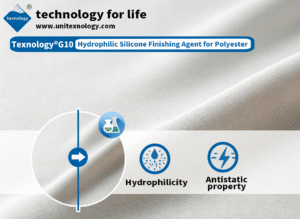
In textile finishing, polyester and other synthetic fibers and blends have long struggled with poor breathability, static buildup, easy emulsion breakdown, and silicone spots. As a result, these issues lower fabric appearance and texture. Moreover, they limit fabric quality upgrades and added value. However, to address the drawbacks of traditional silicone oil agents, a hydrophilic silicone finishing agent has emerged. In particular, it solves key finishing problems for chemical fiber fabrics. Among these products, Texnology®️G10 hydrophilic silicone finishing agent is a high-end functional textile auxiliary. Furthermore, it supports large-scale production. Consequently, it has become a core choice for many fabric mills that want to upgrade fabrics and build differentiated advantages.
1. One Agent, Multiple Functions, Wide Compatibility: Texnology®️G10 Hydrophilic Silicone Finishing Agent Works on Many Fabrics
Texnology®️G10 is highly compatible. It works not only on polyester, but also on polyester blends, nylon, acetate, spandex, and polypropylene. In addition, this hydrophilic silicone finishing agent fits standard dyeing and printing processes. Fabric mills do not need to rebuild production equipment. It upgrades hydrophilicity, moisture wicking, and breathability for many fabrics in one step. This greatly reduces new-product R&D and process adjustment costs for fabric mills.
2. Moisture Absorption, Breathability, and Antistatic Comfort: Texnology®️G10 Reshapes Synthetic Fiber Performance
Traditional silicone oil agents can block fabric pores, trap heat, and weaken sweat absorption. In contrast, Texnology®️G10 hydrophilic silicone finishing agent delivers excellent moisture absorption and breathability. The treated fabric quickly guides moisture and sweat away from the skin. It fully solves the dry, stuffy, and non-absorbent problems of synthetic fibers. It also creates a moisture-wicking, quick-dry effect. At the same time, it gives man-made fiber fabrics stable antistatic performance. It effectively reduces static cling, dust pickup, and ash buildup in autumn and winter. It perfectly suits high-end upgrades for next-to-skin clothing, home textiles, and sportswear.
3. Low Yellowing, Shear Resistance, and No Emulsion Breakdown:Texnology®️G10 Hydrophilic Silicone Finishing Agent Supports Stable Mass Production
Mass production and stability are core needs for dyeing and printing companies. Texnology®️G10 hydrophilic silicone finishing agent offers low yellowing as a key process advantage. It fits white and light-colored fabric processing. It does not damage the original color or appearance of the fabric. Unlike ordinary silicone oils, this hydrophilic silicone finishing agent resists shear, avoids emulsion breakdown, and creates no silicone spots during continuous bulk processing. As a result, operators do not need to stop machines often for cleaning. This improves production efficiency and lowers equipment maintenance costs. It balances finished fabric quality with mass production economics. Therefore, it is a cost-effective auxiliary for fabric mills seeking high-quality upgrades.
In short, Texnology®️G10 hydrophilic silicone finishing agent helps polyester and blends breathe better, feel drier, and stay free from static. It also keeps production stable and clean. For fabric mills, it is a practical way to create differentiated, high-value fabrics.