
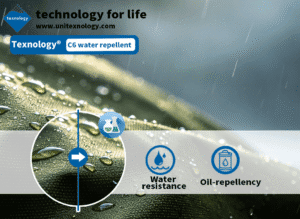
With the official implementation of China’s Key Controlled New Pollutants List (2023 Edition) on March 1, 2023, PFOA (C8) and its related compounds are now banned in most industrial sectors. Only seven exempted uses remain, including semiconductors, specialty protective textiles, and implantable medical devices. For traditional application fields such as textiles, papermaking, leather, and coatings, finding safe, compliant, and high-performance alternatives has become a mandatory requirement for survival and growth.
In this context, C6 water repellent—based on short-chain fluorochemicals—delivers excellent water, oil, and stain resistance along with chemical stability. It meets performance needs in most scenarios and serves as an ideal replacement for C8-based products. For textile mills, switching to C6 water repellent is a practical step toward short-chain chemistry and greener production.
Key Advantages of C6 Water Repellent
Environmental compliance – C6 water repellent degrades faster in the environment than C8, aligning with global regulatory trends and China’s new pollutant control requirements.
Outstanding performance – It provides superior water, oil, and stain resistance across a wide range of fabrics and finishing processes.
Top C6 Water Repellent Products from Lianzhuang Chemical
1. Texnology®️-FCB058 – Durable Water- and Oil-Repellent Finishing Agent
Texnology®️-FCB058 is a multifunctional agent that excels in water, oil, and stain resistance, plus remarkable wash durability and dry-cleaning resistance. Treated fabrics form beads of liquid that roll off easily. For daily cleaning, you simply use a tissue or towel to wipe away spills—no complex care required. This C6 water repellent significantly improves fabric ease-of-care and maintenance convenience.
2.Texnology®️-LG62 – Triple-Protection & Easy-Release Finishing Agent
Texnology®️-LG62 features a specialized fluorochemical structure that combines excellent water, oil, and stain resistance with easy-release properties. Garments made from treated fabrics allow stains to be wiped off with a damp cloth or removed completely through routine washing. This C6 water repellent also shows low yellowing and minimal color change, preserving the original shade and hue. Moreover, it maintains high-level protection even after multiple washes, making it a reliable choice for long-lasting performance.
3.Texnology®️-560 – Low-Temperature Crosslinking Water Repellent
Texnology®️-560 forms a crosslinked film at just 110°C, delivering outstanding water repellency and anti-wicking performance. Treated fabrics often achieve perfect scores in water resistance tests. The product also offers good wash durability. Its low-temperature curing feature (only 110°C) is especially valuable for production lines without high-temperature drying equipment (above 140°C). This C6 water repellent works widely for shoe materials and webbing anti-wicking finishing. It leaves a soft hand feel, so you usually do not need additional softeners—simplifying your process and reducing costs.
4.Texnology®️-FCB028 – Cost-Effective Water Repellent for Polyester
Texnology®️-FCB028 stands out for its exceptional cost performance. For polyester fabrics, a recommended dosage of only about 1% delivers excellent water repellency. This C6 water repellent effectively lowers treatment costs while maintaining protective performance—an economical solution for high-volume production.
Key Considerations When Switching to C6 Water Repellent
For textile mills planning to adopt C6 water repellent, pay attention to these factors:
Substrate and process adaptation – Adjust formulations and parameters for different materials such as woven, knitted, or nonwoven fabrics.
Performance validation – Evaluate critical indicators like penetration, uniformity, and durability to ensure final products meet your quality standards.
Supply chain management – Request environmental and safety data sheets from your upstream suppliers. Ensure full traceability and testing to confirm that no banned C8 substances remain in your supply chain.
Clean production – Even though C6 water repellent poses lower environmental risks, you must still follow clean production principles and minimize emissions during finishing operations.
Conclusion
As global environmental regulations tighten and the industry pushes for greener upgrades, C6 water repellent is not only a compliant response to PFOA bans—it is also a key technological pathway for sustainable development. Zhuangjie Chemical remains committed to providing high-performance, traceable, and eco-friendly C6 water repellent solutions. For textile mills, this transition ensures smooth regulatory compliance while boosting competitiveness in a changing market.