
Pretreatment is the starting point of textile finishing. Lianzhuang pretreatment auxiliaries series also decides final quality. In real production, many mills face stubborn issues: hard water causes scaling and calcium stains; metal ions catalyze hydrogen peroxide to create holes in bleaching; removed oils and sizes redeposit as yellow or oil stains; poor degreasing leads to low whiteness, low capillarity, uneven dyeing, and severe shade differences. These problems lower fabric quality, cause rework and waste, and block cost reduction.
1. Why is pretreatment so important?
Pretreatment is the first and one of the most critical steps in dyeing and finishing. Grey fabric contains sizing agents, oils, waxes, pectin, and other impurities from weaving. If not removed thoroughly, they directly affect dyeing, printing, and finishing. Pretreatment quality determines the final product grade. Good pretreatment means half the dyeing job is done.
2. Four common problems from poor pretreatment
Problem 1: Hard water causes calcium stains, rust spots, and scaling
If water hardness is high, calcium, magnesium, and iron ions react with detergents to form insoluble metal salts. This reduces detergent power. These salts deposit on fabrics, making them stiff and rough, forming stains. They also form silicate scale on equipment, reducing machine life and efficiency.
Problem 2: Pinholes in peroxide bleaching
Pinholes usually result from peroxide reacting with heavy metal ions like iron. Metal ions catalyze rapid local oxidation of peroxide, damaging fiber strength and causing holes. Oil stains containing copper or iron, or contact with metal parts during bleaching, can trigger this.
Problem 3: Redeposition of impurities causes yellow spots, oil spots, and size spots
During pretreatment, synthetic oils, silicone oils, and chemical sizes removed from fabrics, if not fully emulsified and dispersed, redeposit onto the fabric. Using river water often causes yellow spots because organic suspended matter does not disperse well.
Problem 4: Poor degreasing leads to low whiteness, low capillarity, and uneven dyeing
If oils, waxes, and seed hulls are not removed completely, whiteness and capillarity suffer. This leads to uneven dye penetration, shade differences, and low color yield. For elastic fabrics containing spandex, residual oils often cause white spots after dyeing.
3. pretreatment auxiliaries solutions
TEXNOLOGY®CTW water softener – solves water hardness and pinhole problems
TEXNOLOGY®CTW offers excellent softening and chelating power for calcium, iron, and magnesium ions. It also disperses various impurities. Add it in peroxide bleaching together with a stabilizer, in both steaming and cold pad‑batch processes. It controls peroxide decomposition, prevents pinholes, improves whiteness and levelness. It also removes calcium, iron deposits, and silicate scale from equipment. Suitable for pretreatment, dyeing, and soaping.
TEXNOLOGY®CH02 chelating dispersant – tackles metal ions and equipment soiling
This product disperses and suspends impurities well, preventing soiling on equipment and fabrics. It complexes metal ions effectively and removes them. It also has strong scale‑inhibiting and scale‑removing properties, gradually dissolving calcium, magnesium, iron deposits, and silica scale. It resists acids, alkalis, oxidizers, and reductants, and is compatible with common auxiliaries. It removes unfixed reactive dyes in soaping after dyeing or printing without affecting shade or whiteness. It is non‑foaming, avoiding metering errors and fabric tangling.
TEXNOLOGY®STJ penetrant – solves uneven penetration and low color yield
TEXNOLOGY®STJ gives good penetration, lubrication, rewetting, and emulsifying/cleaning effects. As a dyeing penetrant, it helps dyes dissolve and penetrate quickly, giving deeper color yield. It has good compatibility and low foam. It suits sizing, desizing, scouring, and bleaching. Its excellent penetration ensures rapid and uniform liquor penetration, preventing uneven dyeing and streaks.
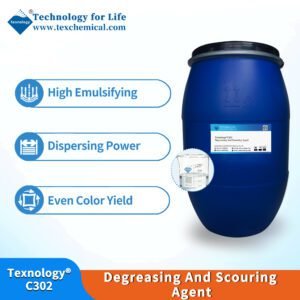
TEXNOLOGY®C302 degreasing– tackles oil stains, whiteness, and capillarity
This agent offers excellent dispersing, cleaning, penetrating, and emulsifying power. After treatment, whiteness, capillarity, strength, and seed hull removal reach high levels. It removes oils and restores fabric whiteness. Its good cleaning power builds a solid base for dye penetration. It reduces dyeing defects from oils and raises first‑pass success.
Pretreatment is the first gateway to quality. TEXNOLOGY®CTW, TEXNOLOGY®CH02, TEXNOLOGY®STJ, and TEXNOLOGY®C302 build a complete system from four angles: water softening/scale removal, chelating/dispersing, efficient penetration, and powerful degreasing. Choosing the right auxiliaries avoids production problems, improves quality, lowers rework, raises efficiency, and creates real economic value.
With over 20 years of deep focus in the textile auxiliary industry, Guangzhou Lianzhuang Technology Co., Ltd. has always been committed to the R&D, production, and application of auxiliaries.
From pretreatment to dyeing and then to finishing, we provide a truly one‑stop service for the textile printing and dyeing supply chain.
We insist on the philosophy “Let technology for life.” We not only offer standard products but also excel in developing customized functional finishes based on fabric needs, such as antibacterial, waterproof, flame retardant, softener, and antistatic solutions.
We make technology practical and production more efficient. For inquiries, please call: +86 18054231589
