
Tear strength matters. It measures the force needed to rip a fabric open. Mills test this in Newtons or kgf. Outdoor jackets, workwear, and tents all require passing this test. Many mills face the same headache: all other specs pass, but tear strength sits right at the borderline.
Common test methods include the Elmendorf tear test (ASTM D1424) and the trouser tear test (ISO 13937). Fabric tearing happens in two steps. First, an initial cut forms. Second, the cut grows larger. The fabric’s resistance depends on three things: yarn strength, yarn slippage at crossing points, and the strength of fiber molecular chains.
Nylon fabrics with fine yarns—like 20D or 30D—often struggle here. Low-density weaves also show weak tear performance. The same goes for fabrics that go through sanding or high-heat setting. These processes reduce yarn mobility and weaken the structure.
That is where a nylon tear strength enhancer comes in. This additive forms crosslinks inside the fibers. It limits molecular chain slippage. As a result, the fabric becomes harder to tear.
Three Ways to Improve Tear Strength
Mills have three main options. Each has its own trade-offs.
Option one: use thicker yarns.
Heavier yarns give more strength. But they also add weight. This conflicts with the lightweight trend in outdoor apparel.
Option two: change the weave structure.
Different interlacing patterns allow more yarn movement. This can boost tear resistance. However, design constraints and existing fabric inventory often block this route.
Option three: apply a tear strength enhancer in finishing.
This method adds no weight. It does not change the greige fabric. It works in the same finishing line. For many mills, this is the most practical fix.
Today’s market offers many nylon tear strength enhancer products. They vary in performance. Some give big strength gains but cause yellowing. Others change the fabric hand feel too much. Still others do not play well with water repellents.
Take Texnology® FCL002A as an example. This nylon tear strength enhancer delivers solid tear improvement. It keeps yellowing low. It affects hand feel only slightly. Plus, it works in one-bath processes with fluorocarbon or other finishes.
How Texnology® FCL002A Works in Finishing
Texnology® FCL002A is a nonionic emulsion. It appears white to yellowish. Its main ingredient is polyethylene. It dissolves easily in water.
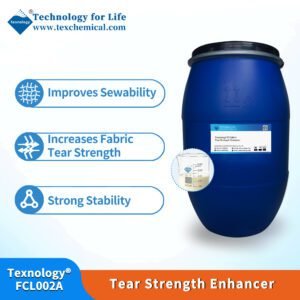
This nylon tear strength enhancer suits nylon, polyester, and blended fabrics. After treatment, fabrics show higher tear values. Yellowing stays minimal. Hand feel remains soft and natural. These qualities make it ideal for jackets, workwear, tents, and backpacks.
The nonionic nature brings a big advantage. It resists demulsification and settling. That means fewer problems when mixing with waterproofing agents or dye-fixing chemicals. Mills also report less foaming and fewer roller-sticking issues during production.
Using this nylon tear strength enhancer is straightforward. It works in pad-dry-cure lines. Typical dosages range from 30 to 60 g/L. Process conditions follow standard finishing parameters.
Practical Advice for Dyeing Mills
Choosing the right nylon tear strength enhancer is about balance. Strength gain matters, but so do other factors. Yellowing can ruin light-colored fabrics. Stiff hand feel can lower product quality. Bath incompatibility can cause downtime.
Start with small trials. Test the enhancer with your specific fabric. Check tear strength before and after. Also check color change, hand feel, and wash durability. If you plan to use a water repellent, test the one-bath compatibility first.
Keep records of your process conditions. Temperature, pH, and pad pressure all affect performance. Adjust these variables to get the best balance.
Remember that no single product fits every need. But a good nylon tear strength enhancer—like Texnology® FCL002A—offers a reliable starting point. It covers the most common requirements for outdoor and workwear fabrics.
Final Thoughts
Tear strength does not have to be a bottleneck. Understanding the basics helps you make better choices. Thicker yarns and weave changes are valid, but they come with limits. Finishing additives give you flexibility without changing your base fabric.
A nylon tear strength enhancer works by crosslinking fiber molecules. It reduces slippage and raises tear force. The right product also keeps yellowing low, hand feel pleasant, and bath stability high.
For mills, the goal is simple: pass the test, keep quality, and run smoothly. With careful product selection and process tuning, that goal is within reach.
