
Focus keyword: nonwoven antistatic agent (appears in title, first paragraph, and subheadings)
On the production line for medical masks, gowns, and surgical drapes, there is a hidden risk: static electricity. Many mills work hard on fabric smoothness and filtration efficiency. However, they often overlook the chain reaction caused by static.
Static lowers processing speed. Static harms product cleanliness. Static creates safety risks in hospitals. Therefore, medical nonwovens need proper anti-static treatment.
Why Every Medical Nonwoven Needs a Nonwoven Antistatic Agent
Most medical nonwovens use polypropylene (PP) fibers. These fibers absorb very little moisture. In a dry production environment, friction between fibers builds up static charges easily. And those charges cannot escape by themselves. So they keep piling up.
This built-up static causes three real problems:
First, it slows down production. Static makes nonwoven fabric stick during winding and slitting. In cutting and sewing, the fabric clings to machine tables. It cannot feed smoothly. This hurts your production speed.
Second, it hurts cleanliness. A charged nonwoven surface acts like a dust magnet. It pulls in airborne dust and fiber bits. For medical products, this is a serious contamination risk. Dust on a mask or gown can fail hygiene tests. In a cleanroom, it may even scrap the whole batch.
Third, it creates safety risks in medical settings. In an operating room, static discharge can disturb sensitive equipment. More importantly, a charged gown easily attracts virus-laden droplets or aerosols. That raises the exposure risk for healthcare workers.
For these reasons, medical nonwovens usually need three properties together: anti-static, alcohol repellent, and plasma repellent (called “triple resistance”). Among these, the anti-static function relies on a nonwoven antistatic agent. For example, Texnology® NW16 is a product made specifically for this need in medical nonwoven finishing.
How Does a Nonwoven Antistatic Agent Work?
To solve static on nonwovens, the most common and easiest method is surface treatment with a nonwoven antistatic agent. Take Texnology® NW16 as an example. Its working principle has two parts:
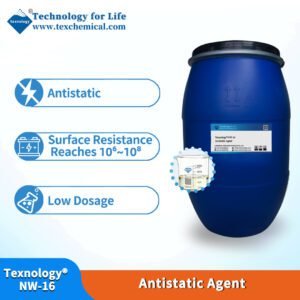
First, it forms a thin, conductive, water-loving layer on the fiber surface. This layer lowers the fabric’s surface resistance. Then the static charge from friction can “flow away” instead of staying on the fabric. Think of it as building an escape path for static.
Second, it lowers the friction between fibers. Friction is a main source of static. After treatment, the fabric feels smoother. So less charge builds up when fibers rub together. Both effects work together. As a result, the static half-life drops sharply.
Product Features and Application Tips for Texnology® NW16
Texnology® NW16 is made of modified organic phosphate compounds. It targets the anti-static needs of nonwovens and synthetic fabrics. Here are its key features:
- Stable anti-static effect – both general and strong levels available.Depending on the dosage, this nonwoven antistatic agentcan give you either normal anti-static or strong anti-static performance. It works for daily protective products. It also works for surgical gowns and other high-demand medical gear. When used together with “triple resistance” auxiliaries in the same bath, surface resistance stays at ≤1.0×10¹⁰ Ω. This meets common anti-static standards while greatly improving process efficiency.
- It keeps the original fabric feel.Texnology® NW16 has little effect on hand feel. After treatment, the nonwoven stays soft. This is important for hygiene products and medical supplies.
- Very low impact on alcohol repellency.Many antistatic agents conflict with water/oil repellent or alcohol resistant treatments. That lowers alcohol protection. But Texnology® NW16 has very little effect on alcohol resistance. So it is a good fit for medical nonwovens that need all three “triple resistance” standards.
- Wide application range.Besides nonwovens, this nonwoven antistatic agentalso works on polyester, nylon, acrylic, and other synthetics or their blends. You can use it for underwear, sportswear, jackets, and many other garments.
Summary
Static on nonwovens directly affects your processing speed, product cleanliness, and medical safety. That is why choosing the right nonwoven antistatic agent is a must in production. Texnology® NW16 works by building a conductive path on fibers, letting static charges escape in time. It lowers surface resistance based on your material and needs. Its main features include: keeping the original hand feel, good compatibility with triple-resistance finishing, and wide applicability. Whether for medical nonwoven triple resistance or general anti-static on synthetic fabrics, this product delivers.
