
For technicians in dyeing and finishing mills, non-iron finishing has become a standard process for mid-to-high-end shirts, workwear, and hotel linens. Consumers want wrinkle-resistant fabrics. Brands demand specific non-iron ratings. As a result, resin finishing is widely used on cellulose fiber fabrics.
But production experience shows a clear problem. Resin crosslinkers improve fabric smoothness. Yet they often cause a sharp drop in tear strength. Seams tear too easily. Knits show needle holes during sewing. These issues lead to customer returns and quality claims.
Many dyeing mills add cationic softeners. They try to improve fiber surface lubrication. However, the real-world results are poor. High-temperature yellowing occurs. Ionic incompatibility causes emulsion breaking and roller sticking. The root problem remains unsolved.
Lianzhuang Technology developed Texnology®FCL002A fabric tear strength enhancer. This product offers a real technical solution.
Why does non-iron finishing “hurt” fabric? And why can’t traditional softeners fix it?
Non-iron finishing uses resin crosslinkers. These crosslinkers form strong chemical “bridges” between cellulose molecular chains. They lock the chains permanently. This gives the fabric wrinkle recovery.
But locking brings two deadly results.
First, the catalyst releases free acid during high-temperature curing. This acid hydrolyzes and breaks molecular chains. The damage is irreversible. Think of it like internal “bone fractures” inside the fibers.
Second, fibers normally relieve stress by slipping under tension. Crosslinking takes away that slip ability. Stress then concentrates on just a few molecular chains. They snap easily.
Add to this the high setting temperature of 120–160°C. Cotton, linen, and lyocell often lose more than 30% of their original tear strength.
What makes things worse? Many operators try cationic softeners for “lubrication.” But these softeners yellow badly at high temperatures. Light and white fabrics fail whiteness requirements. The softener also reacts with resin in the same bath. Ionic incompatibility leads to emulsion breaking and roller sticking. Spots and silicone stains appear on the fabric surface. Defect rates rise.
Even worse, sewing needle holes do not disappear. Sometimes they get worse. The softener only “oils” the surface. The fiber still breaks.
Does your fabric face the same trouble? The higher the non-iron rating, the easier it tears. And traditional methods just add more problems.
Features and application of Texnology®FCL002A fabric tear strength enhancer
Texnology®FCL002A fabric tear strength enhancer completely avoids these issues. Its chemistry is a non-ionic polyethylene emulsion. It does not cause yellowing. It does not harm whiteness. You can even use it with optical brighteners. Whitening and softening happen in one step.
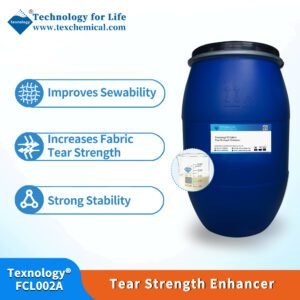
How it works – very straightforward. Texnology®FCL002A fabric tear strength enhancer forms a uniform, flexible protective film on fiber surfaces. This film increases friction between yarns. During tearing, the friction stops yarns from being pulled out or broken.
Real test data shows tear strength improvement of over 20% after using Texnology®FCL002A fabric tear strength enhancer.
Moreover, the product is non-ionic. It works in one bath with resin, water repellents, catalysts, and other auxiliaries. No emulsion breaking. No roller sticking. This shortens the finishing process significantly.
For knitted fabrics, Texnology®FCL002A fabric tear strength enhancer delivers better sewability. It reduces needle holes during high-speed sewing. It protects fabric integrity.
After using this Texnology®FCL002A fabric tear strength enhancer, technicians no longer have to choose painfully between “non-iron rating” and “strength retention.”
Application method – simple pad application. Add Texnology®FCL002A fabric tear strength enhancer together with resin in the same bath. Then dry and set. No extra equipment. No extra steps. After one padding and one setting, you will see a clear improvement in tear strength.
Conclusion
Let’s go back to what non-iron finishing really does. To make fabric wrinkle-free and easy care, resin crosslinkers create chemical “bridges” between fiber molecules. But this creates two types of damage. Acid hydrolysis breaks fibers like fractures. Loss of slip ability causes stress concentration. The fabric tears easily. Sewing leaves dense needle holes.
Traditional softeners do not solve this. Instead, they bring yellowing, roller sticking, and emulsion breaking.
Texnology®FCL002A fabric tear strength enhancer changes the old rule that “good non-iron means poor tear strength.”
Three key advantages:
New mechanism
– the non-ionic polyethylene emulsion forms an elastic protective film on fibers. It increases friction between yarns. It effectively stops yarn pull-out or breakage during tearing. This solves the stress concentration problem at its root.
Stable performance
– no yellowing, no whiteness loss. It works with optical brighteners. The non-ionic system ensures stable baths with resin, water repellents, and other auxiliaries. No emulsion breaking. No roller sticking.
Process friendly
– no production line changes needed. Use normal padding in one bath with resin. Dry and set in one go. No extra time or steps.
For dyeing mills and fabric mills that want high non-iron ratings without seam tears, needle holes, or customer complaints – this is a real technical upgrade. From painful choice to both benefits.
One step. One setting. Over 20% better tear strength. Stronger fabric. Happier customers.
