
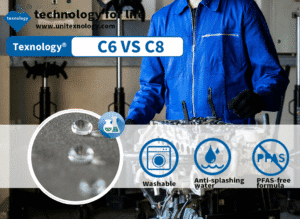
Whether you are a garment manufacturer, a home textile producer, or someone caring for outdoor gear, many people confuse C6 water repellent with fluorine‑free water repellent when selecting fabric water repellents. The core differences lie in composition, working mechanism, and application scenarios. C6 water repellent is a fluorinated water repellent, while fluorine‑free water repellent contains no fluorochemicals at all.
Considering environmental regulations: China’s List of Key Controlled New Pollutants (effective 2023) explicitly prohibits the production, processing, and use of persistent and potentially hazardous PFOA‑related substances (perfluorooctanoic acid, its salts, and PFOA‑related compounds), with few exemptions. Traditional C8 fluorinated water repellents have been gradually restricted due to residual PFOA. C6 water repellent serves as a compliant alternative, while fluorine‑free water repellent is a more thoroughly eco‑friendly choice that completely avoids PFAS‑related environmental risks.
C6 water repellent (also called C6 repellent) uses C6 short‑chain fluorinated technology. It contains no APEO, and PFOA/PFOS levels are below detection limits, allowing normal export. Compared with C8, its oil repellency is slightly lower, but its breakdown products (e.g., PFHxA, PFBS) pose lower risks of bioaccumulation and persistence. It strikes a balance between water repellency performance and green manufacturing. Today, commercial C6 water repellent products already meet finishing requirements such as wash durability, high oil repellency, and stain release. They are widely used in outdoor jackets, workwear, tablecloths, tents, luggage, and footwear materials.
For example, Texnology® FCB058 from Lone Star Technology is a water‑soluble C6 water repellent for cotton. It works on various fabrics (cotton, polyester, nylon, especially cotton), providing excellent and durable water, oil, and stain repellency without affecting breathability or hand feel. It is mainly used for outdoor jackets, workwear fabrics, and home textiles. Texnology® FCB028 is an economical C6 water repellent with three‑proof (water, oil, stain) finishing effects and excellent waterproof and anti‑wicking performance. It targets wall fabrics, apparel, umbrellas, curtains, wallpapers – specifically solving the high cost of fabric waterproofing.
TEXNOLOGY® FCB0562 is a non‑ionic C6 water repellent. Fabrics finished with it achieve a water repellency rating of 100 and withstand 20 washes. Its outstanding stability and compatibility effectively solve the “water repellent spotting” problem during production, and it enables multi‑functional composite finishing such as water repellent + stiff finish or water repellent + antistatic finish. It is suitable for natural, synthetic, and man‑made fibers.
C6 water repellent represents the current balance between performance and regulatory compliance, but it is not the final destination. After all, it still belongs to the PFAS family. Under the wave of environmental protection, it will eventually be replaced by more thorough alternatives. Especially when you do not need oil repellency, you can choose a fluorine‑free, readily degradable, and safer product: fluorine‑free water repellent.
Fluorine‑free water repellent contains no fluorocarbon resin. Compared with fluorinated water repellents, it does not accumulate in living organisms and is easily degraded, making it a safer and more decomposable textile water repellent. Fluorine‑free water repellent generally provides basic functions such as water repellency, anti‑wicking, and wash durability. It is suitable for cotton, polyester, nylon, and their blends. Applications include: outdoor gear (umbrellas, tents, ordinary windproof jackets without oil repellency), daily clothing (children’s wear, casual wear, sportswear), home textiles (curtains, sofa fabrics, mattress ticking), and footwear/luggage (shoe uppers, backpacks requiring anti‑wicking). Some new fluorine‑free water repellents already achieve wash‑fast water repellency comparable to C6 water repellent, with better fabric hand feel and anti‑wicking performance.
For instance, Texnology® MS330 silicone‑based fluorine‑free water repellent from Lone Star Technology uses a non‑ionic design (carrying no positive or negative charge), allowing it to be used in the same bath with anionic, non‑ionic, and cationic auxiliaries (e.g., softeners, antistatic agents, stiffening agents). Fabrics finished with it feel soft and smooth, with no visible handling marks. It can be air‑dried without drying equipment. It is suitable for waterproof finishing of fabrics, paper, and leather – specifically solving problems like poor water repellency, harsh hand feel, and lack of drying equipment.
So, should you choose C6 water repellent or fluorine‑free water repellent? There is no single answer – it depends on your product positioning and customer needs.
- If you need oil repellency, wash durability, and export compliance → C6 water repellentis the current mature solution.
- If you pursue environmental friendliness, safety, a fluorine‑free label, or only need water repellency/anti‑wicking → fluorine‑free water repellentis the more sustainable direction.
The environmental trend will not reverse. From C8 to C6 to fluorine‑free, every step is an evolution. No matter which stage you are at, understanding these differences in advance and making a rational choice will help you stay solid in a changing market.
