
1、Better detection methods now expose “hidden PFAS”
In the past, limited detection methods could not find PFAS residues in textiles. That has changed completely. The EU enforced EN 17681-1:2025 in October 2025. This new PFAS testing standard uses advanced “alkaline hydrolysis” technology. It requires total organic PFAS ≤ 50 ppm. This method reveals hidden PFAS that previous tests missed.
Meanwhile, combustion ion chromatography greatly improves detection accuracy. The method burns textile samples at high temperature (900–1100°C). All PFAS compounds – organic or inorganic – break down into fluoride ions. An ion chromatograph then measures the fluoride ions quantitatively. In other words, today’s technology finds any form of PFAS. If a “PFAS‑free” product shows excess PFAS, the problem lies somewhere in production or the supply chain.
https://texchemical.com/2175-2/
2、What “PFAS‑free” really means: no intentional addition, not zero detection
Many companies overlook a key point. Chinese national standards set limit values for “PFAS‑free” to allow for non‑intentional trace contamination – not to permit adding PFAS ingredients. For example, the limit for PFOA is about 1 μg/m². This number assumes possible micro‑contamination from residual fluorinated compounds in dyeing vats or stenters. It does not allow manufacturers to use fluorinated raw materials.
Therefore, if you claim a product is “PFAS‑free”, you must guarantee no PFAS compounds at all. Once your product label or website says “PFAS‑free” or “PFAS‑free”, you promise zero PFAS. Any positive detection can lead to false advertising charges, regulatory fines, and reputational damage.
3、Cross‑contamination: the most hidden cause
This is the most common and most overlooked reason for excess PFAS on “PFAS‑free” fabric. The problem usually does not come from the water repellent itself. It occurs during production and processing. Below are typical contamination scenarios.
3.1 Residues in stenter frame ducts and chambers
The stenter frame is a major source of contamination. If a machine processes both fluorinated and PFAS‑free orders, high temperature vaporizes residual fluoropolymers in ducts and chambers. These vapors then deposit on the next batch of fabric. Tests show that even plain water‑repellent fabrics can show PFAS markers after re‑setting in the same machine.
3.2 Padder, guide rollers, and poor cleaning
Dirty dyeing vats, shared weighing buckets, unlabeled stirring rods, roller residues – these small details become hidden pathways for PFAS. One factory found PFOA on a PFAS‑free order because workers mixed weighing buckets.
3.3 Background PFAS in water
Some factories use recycled water. Its PFAS concentration can reach 120 μg/L. Fabric processed with such water very often exceeds PFAS limits. In areas with high natural PFAS in groundwater, even raw water exceeds limits. You cannot use it without reverse osmosis treatment.
3.4 Effect of recycled water and dyed fabric
PFAS‑free water repellents need high‑quality water. If the factory uses recycled water containing residual auxiliaries, or if dyed fabric is not thoroughly washed before treatment, leftover PFAS may affect final test results.
4、PFAS from raw materials or auxiliaries: a pollution chain from source to finished product
Even if the PFAS‑free water repellent contains no PFAS, other chemicals can bring PFAS into the process. In textile production, fluorinated compounds exist in many functional auxiliaries, such as softeners, smoothing agents, and antistatic agents. PFAS from these auxiliaries can migrate onto the fabric.
Even more hidden: fluorinated films (e.g., PTFE membranes). Although not considered “auxiliaries” in the finished product, they also release fluorinated compounds and cause test failures.
5、Regulations tighten quickly: a red line for mills
PFAS are called “forever chemicals”. They hardly degrade, accumulate in living organisms, and long‑term exposure may harm human health. Global control is increasing. 2026 is a critical year for PFAS compliance.
- France:Bans PFAS in textiles and footwear from January 2026.
- Denmark:Bans import or sale of PFAS‑containing clothing and footwear from July 1, 2026.
- EU:Advancing a total PFAS restriction under REACH. Proposed total organic PFAS ≤ 50 mg F/kg.
- China:PFAS are on the “List of Key Controlled New Pollutants”. New national standard GB/T 31126.1‑2025 takes effect in May 2026. It specifies PFAS testing methods for the first time.
6、Practical actions to prevent “PFAS exceedance”
To completely solve the problem of “PFAS‑free products failing PFAS tests”, Lianzhuang Technology recommends that dyeing and printing mills work on the following fronts.
6.1 Fully separate production lines
Dedicate specific machines for PFAS‑free products – stenter frames, dyeing vats, padders – and keep them separate from fluorinated orders. If you cannot do that, perform high‑temperature deep cleaning. Regularly clean the feeding tank with acid solution (pH ≤ 3).
6.2 Strictly control water quality
Use reverse osmosis or activated carbon filters to purify process water. Avoid PFAS residues from recycled water.
6.3 Manage your supply chain
Do not look only at the water repellent. Ask all auxiliary suppliers (including softeners, smoothing agents) for their PFAS content. Control contamination at the source.
6.4 Verify oil repellency of the product
True PFAS‑free products have poor oil repellency. If your fabric unexpectedly shows good oil repellency, be alert: you may have accidentally added fluorinated components.
6.5 Regular third‑party testing and internal control
Set up an internal PFAS control system. Regularly send samples to third‑party labs for total PFAS and PFAS monomer testing. Find problems before mass production.
6.6 Standard cleaning and changeover procedures
Before changing from fluorinated to PFAS‑free production, strictly follow equipment cleaning procedures. If needed, use a special water repellent remover to eliminate fluorinated residues on equipment surfaces.
7、Lianzhuang Technology’s PFAS‑free water repellent series: applications and advantages
As global PFAS control increases, Lianzhuang Technology has focused on C0 PFAS‑free water repellents for many years. We built a complete technical system covering R&D, production, and application services. Lianzhuang Technology Co., Ltd. started in 2007. We manufacture textile auxiliaries including R&D, production, and sales. We hold ISO9001:2000 certification. Most of our products pass eco‑tests from international authorities. Our PFAS‑free water repellent series contains no PFOA, PFOS, or APEO. They meet EU REACH, OEKO‑TEX, and BLUESIGN standards.
Our product matrix covers different fiber types and performance requirements.
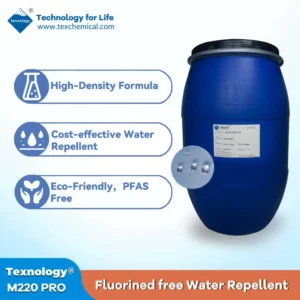
- TEXNOLOGY®M220PRO Economy PFAS‑free water repellent– acrylic polymer dispersion. Initial water repellency 100 points. After 10 washes, still above 80 points. Can be used in one bath with other finishing auxiliaries.

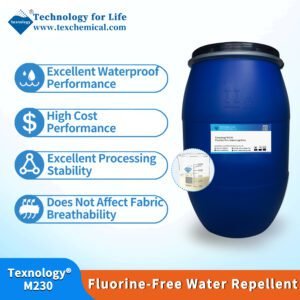
TEXNOLOGY®M220PRO Economy PFASfree water repellent - TEXNOLOGY®M230 PFAS‑free water repellent– good cost performance. For cellulosic, synthetic, and blended fabrics. Padding process, easy operation, high stability, suitable for continuous production.
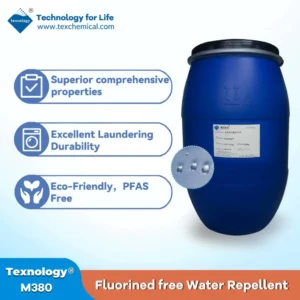
TEXNOLOGY®M230 PFASfree water repellent - TEXNOLOGY®M380 PFAS‑free water repellent– paraffin and acrylic polymer combination. Solves common problems like emulsion breaking and roller sticking. Only 1–2% add‑on gives initial 100‑point water repellency.
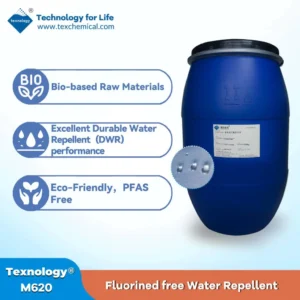
TEXNOLOGY®M380 PFASfree water repellent - Polyurethane‑based PFAS‑free water repellents TEXNOLOGY® M620 and TEXNOLOGY®M630 – excellent water repellency and wicking resistance on many fiber types. Good wash durability. Suitable for fabric finishing, webbing, and shoe materials. Easily achieves 100‑point water repellency. Treated fabric retains good protection after many home washes. Almost no yellowing. Does not affect hand feel or breathability. Improves “finger mark” issues.
TEXNOLOGY® M620 PFASfree water repellents
For cotton and blends, TEXNOLOGY®M620‑EA cotton PFAS‑free water repellent – based on innovative polyurethane chemistry. Gives cotton excellent water repellency while keeping its softness, breathability, and full hand feel. Contains no PFAS and no APEO emulsifiers. Meets international eco‑standards and green textile certifications.
TEXNOLOGY®MS330 silicone PFAS‑free water repellent – fills the gap for low‑temperature processing. Works when dryer temperature is insufficient or you need a spray‑on repellent. Achieves “dry after drip, water repellent” effect.
We also offer specialty products: TEXNOLOGY®M309 non‑ionic PFAS‑free water repellent (for blending with resins), TEXNOLOGY®638 silicone type PFAS-free water repellents (soft hand feel, low color change), TEXNOLOGY®730G Laundry Air Dry PFAS-free water repellents (for fabrics requiring Japanese standard line‑dry after washing), TEXNOLOGY®MY80 anionic type PFAS-free water repellents (for leather internal waterproofing). Each product fits a specific need. We provide customized solutions.
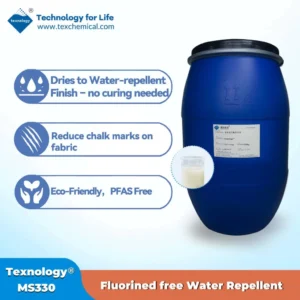
Our PFAS‑free water repellents support padding, dipping, spraying, and roller coating – matching existing mill equipment. In continuous production, customers verified stable water repellency at large scale. This improves productivity and lowers overall cost. We also offer full technical support: formula design, process adjustment, and on‑site trials. We help you switch smoothly to a PFAS‑free system.
We hope this article helps textile professionals understand the real reasons behind “PFAS exceedance”. Lianzhuang Technology’s PFAS‑free water repellent series builds on 19 years of technical experience and rich application practice. We have helped many textile companies overcome trade barriers caused by fluorinated products. For any questions about PFAS‑free water repellents, please contact us. We look forward to discussing with you.
