
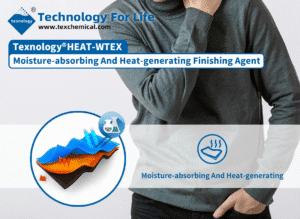
In recent years, “self-heating” fabrics such as thermal underwear and heat-generating base layers have become increasingly popular among consumers. These garments provide extra warmth without the bulk of heavy padding. But can fabrics truly generate heat on their own? What is the underlying principle? And for dyeing and finishing plants and underwear fabric manufacturers, how can this functionality be achieved through finishing technologies?
I. Common Methods for Producing Self-Heating Fabrics
At present, self-heating fabrics on the market are mainly produced using the following three methods:
– **Functional fiber method**:
Additives such as far-infrared ceramic powders or moisture-absorbing and heat-generating materials are incorporated during the spinning process, endowing the resulting fibers with inherent heat-generating properties.
– **Coating method**:
Heat-generating materials (e.g., far-infrared powders) are applied to the fabric surface via a coating process.
– **Finishing padding method**:
The fabric is treated with a moisture-absorbing and heat-generating finishing agent through pad-dry-cure processing to impart moisture-absorbing and heat-generating performance.
Among these, the finishing method has become an effective way for dyeing and finishing plants to respond quickly to market demand, thanks to its simple processing and broad applicability.
II. Working Principle of the Moisture-Absorbing and Heat-Generating Finishing Agent
The principle of moisture-absorbing heat generation is not complicated. During wear, the human body emits water vapor (gaseous water). When this water vapor comes into contact with the fabric and is adsorbed by the fibers, it transitions from a gaseous to a liquid state (condensation). This process releases heat — known as the “heat of condensation.” Conversely, when liquid water evaporates, it absorbs a large amount of heat of vaporization, leading to a cooling effect on the skin.
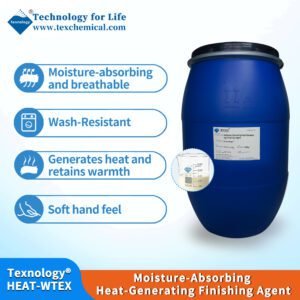
Texnology® HEAT-WTEX Moisture-Absorbing and Heat-Generating Finishing Agents is designed based on this principle. It significantly enhances the fiber’s ability to adsorb gaseous water, converting the water vapor evaporated from the skin into liquid while releasing heat, and slowing down the cooling effect caused by moisture evaporation. This achieves a combined effect of moisture absorption, moisture retention, and heat generation.
III. Applicable Fabrics and Application Advantages
Texnology® HEAT-WTEX Moisture-Absorbing and Heat-Generating Finishing Agents is suitable for various natural and synthetic fibers and their blends, including cotton, viscose, polyester, and acrylic. The finished fabric has a fluffy, soft hand feel without affecting breathability, and can be widely used in products such as base layers, thermal underwear, loungewear, and socks.
Dyeing and finishing plants can apply it using conventional pad-dry-cure processes, requiring no special equipment modifications. For underwear fabric manufacturers looking to differentiate their products and add value, Texnology® HEAT-WTEX Moisture-Absorbing and Heat-Generating Finishing Agents offers a simple and efficient technical pathway.
